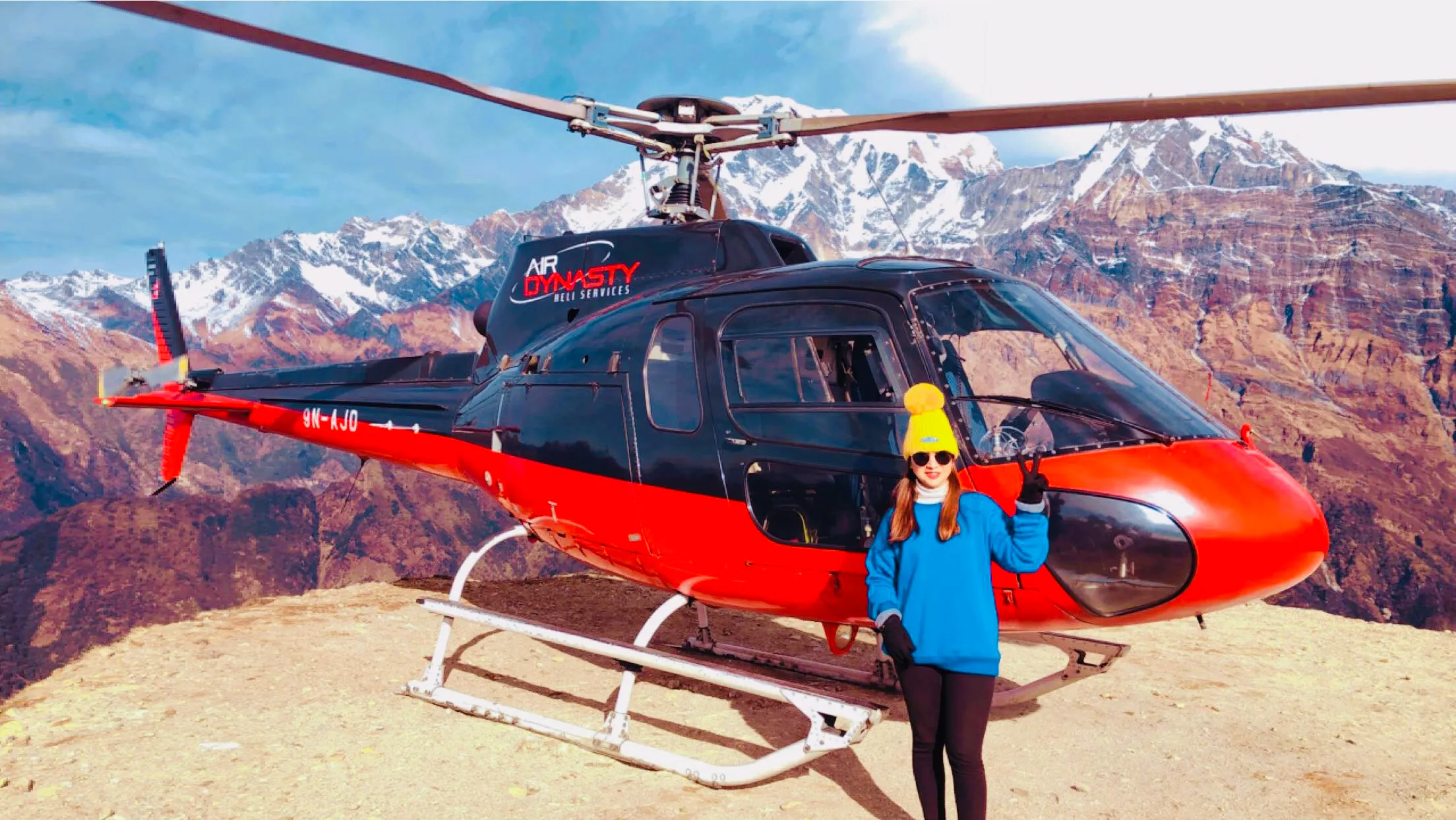
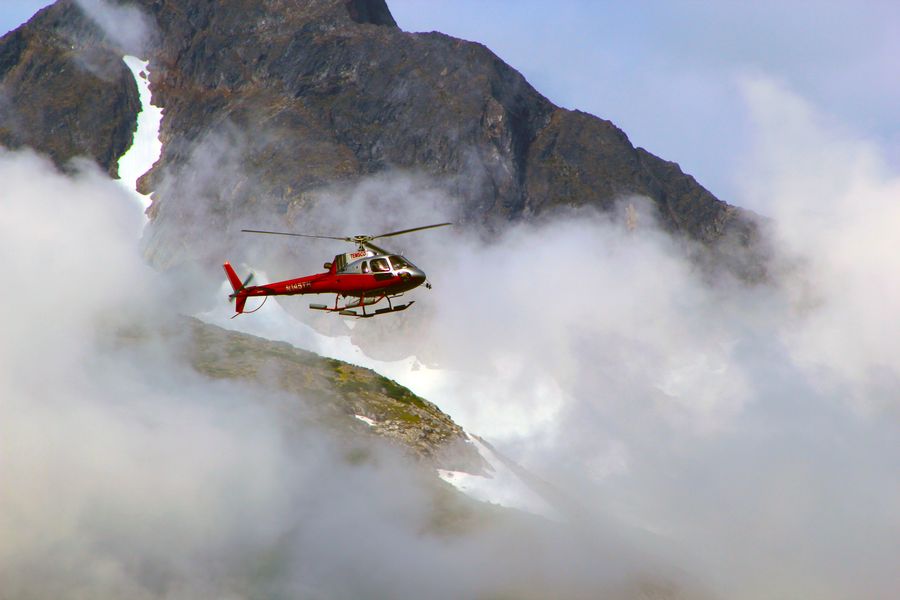
Where the helicopter lands? Annapurna Base Camp or Machhapuchhre Base Camp
The pilot decides on the morning, from the cloud and wind inside the Sanctuary. If ABC is closed in, we tell you before the pilot lands at Machhapuchhre Base Camp. You can accept the lower landing, or fly straight back and treat the morning as a weather cancellation (see section 9). Inside the Sanctuary the safety call always belongs to the pilot, so the landing spot is confirmed on the morning.
| Landing spot |
Altitude |
When the pilot uses it |
| Annapurna Base Camp |
4,130 m |
The plan for every flight. Used whenever cloud and wind allow |
| Machhapuchhre Base Camp |
about 3,700 m |
When cloud sits on ABC but the lower Sanctuary is clear. It is about two hours' walk below ABC, with Machhapuchhre directly above it |
Your time on the ground: 20 to 30 minutes
You get 20 to 30 minutes at Annapurna Base Camp. The pilot sets the exact time on the day for two reasons. You have climbed from 820 m to 4,130 m in 20 minutes, so a short stop is kinder to your body. And cloud usually starts pushing into the Sanctuary within the hour, so leaving on time keeps the flight home safe and clear. Twenty to thirty minutes is plenty for photos, a slow walk around the base camp and a quiet look at Annapurna I. If your group would like longer and the pilot agrees, extra ground time can be added at the airline's rate (see "What is not included").
The rules for flying into ABC
Annapurna Base Camp is inside a protected area, and tourist helicopter landings there are regulated:
- The airline must be registered with Annapurna Rural Municipality. Under the municipality's ABC helicopter fee procedure, in force since April 2023 and strictly enforced since early 2025, each registered airline pays NPR 10,000 per flight, and an unregistered one pays NPR 20,000.
- The number of flights is capped. The procedure allows up to 12 tourist flights to ABC a day. Rescue flights are exempt.
- The conservation area charges every flight and every passenger. The airline pays a fee to the Annapurna Conservation Area Project for each flight, and each passenger needs their own conservation area permit.
What this means for you: we book you with an airline registered with the municipality, all these fees are already inside the USD 500, and in the busiest weeks of October, November and April the morning slots fill up, so book a few days ahead.
Why the helicopter carries only 4 passengers
At 4,130 m the air is about a third thinner than at sea level. A helicopter's rotor blades get less lift from thin air, and the engine produces less power, so the same helicopter can lift far less at the base camp than on the runway in Pokhara. Cold, dry mornings help, which is one more reason this flight leaves early. Warm or humid air reduces performance further.
That is why the pilot asks for every passenger's weight the evening before, weighs everyone again at check-in, and limits the cabin to 4 passengers. It is also why we ask you to leave large bags at your hotel. On the day, the pilot works out the safe load from the temperature and wind inside the Sanctuary.
Altitude and your body: what 30 minutes at 4,130 m means
The air pressure at 4,130 m is about 60% of the pressure at sea level, so each breath brings in a little over half the oxygen you are used to. You climb more than 3,300 m in 20 minutes with no time to adjust, and you will notice it. Most people feel slightly breathless when they walk, and some get a light headache or feel dizzy.
Real altitude sickness takes longer to develop. The US Centers for Disease Control and Prevention (CDC) says acute mountain sickness usually starts 2 to 12 hours after arriving at altitude, often during the first night. It also says day trips to altitude with a return to lower ground the same day are much easier on the body, because the body struggles most with thin air during sleep. On this tour you spend about 30 minutes at 4,130 m and are back in Pokhara, at 820 m, within the hour.
At the base camp:
- Walk slowly and don't run, even for a photo
- Breathe steadily and drink a little water
- Tell the pilot at once if you feel faint, dizzy or very short of breath. There is oxygen on board, and the pilot can take you down within minutes
Talk to your doctor before you book if you have heart disease, a lung condition, high blood pressure, pulmonary hypertension or sickle cell trait, or if you are pregnant. The CDC notes that children are as sensitive to altitude as adults, so keep an eye on young children at the landing.
The Annapurna Sanctuary: a sacred basin
The Annapurna Sanctuary is an oval glacial basin above 4,000 m, ringed by peaks of 6,000 to 8,000 m. Its only entrance is the narrow gorge between Hiunchuli and Machhapuchhre, which drains the Sanctuary's meltwater into the Modi Khola. The walls are so high that even in summer the basin gets only about seven hours of direct sun a day. Annapurna Base Camp sits beside the South Annapurna Glacier, and has a cluster of trekking lodges, so even on a day flight you land in a place where people live and work through the season.
For the Gurung people of the valleys below, the whole basin was sacred. It was believed to hold gold and treasure left by the Nāgas, the serpent gods, and to be a home of gods from Hindu, Buddhist and older traditions. Machhapuchhre was the home of Shiva, and the plume of snow blowing from its summit was the smoke of his incense. Until recent times eggs and meat could not be carried into the Sanctuary.
No outsider is recorded inside the Sanctuary before 1956. That year Colonel Jimmy Roberts spent three days forcing a way up the bamboo-choked Modi Khola gorge from Chhomrong, scouting a route to Machhapuchhre for the 1957 expedition. Wilfrid Noyce's book about that expedition first called the basin "the Sanctuary", and the name stuck.
Today the Sanctuary is part of the Annapurna Conservation Area, Nepal's first and largest conservation area, at 7,629 km². The conservation area limits firewood cutting and grazing inside the Sanctuary, and it receives no regular government operating funds, so the permit included in your seat price pays for its work.
Altitudes on the way in
| Place |
Altitude |
What it is |
| Pokhara Airport |
820 m |
Where the flight starts |
| Chhomrong |
2,170 m |
The big Gurung village at the mouth of the Modi Khola gorge |
| Sinuwa |
2,360 m |
Forest village where the gorge narrows |
| Machhapuchhre Base Camp (MBC) |
about 3,700 m |
The entrance to the Sanctuary, and the pilot's alternate landing |
| Annapurna Base Camp (ABC) |
4,130 m (13,550 ft) |
Where the helicopter lands |
| Annapurna I |
8,091 m |
The summit straight above the base camp |
Annapurna I: the wall above the landing
On 3 June 1950 the Frenchmen Maurice Herzog and Louis Lachenal reached the summit of Annapurna I, the first 8,000 m peak anyone had ever climbed. They did it without bottled oxygen, on the expedition's first attempt, and paid for it with severe frostbite: both men lost toes, and Herzog lost his fingers. They climbed from the north. The face you see from the base camp is the other side, the south face, a 3,000 m wall of rock and ice that has become one of the great tests of Himalayan climbing.
Ghandruk and Chhomrong, the villages of the gorge
The flight up follows the Modi Khola past two of the best-known Gurung villages in Nepal. Ghandruk, a big village of stone houses on a terraced slope, is where the Annapurna Conservation Area began, as a pilot project in 1986. Chhomrong, at 2,170 m, is the last large village before the gorge narrows. It was from here that Jimmy Roberts set out into the gorge in 1956. From the air you see both villages on their ridges, with the terraced fields falling away to the river.
Why book this flight with us
- A local office you can walk into. Visit us at 19 Street Lakeside, Pokhara-6, the day before your flight. Meet the team, ask your questions and pay in person.
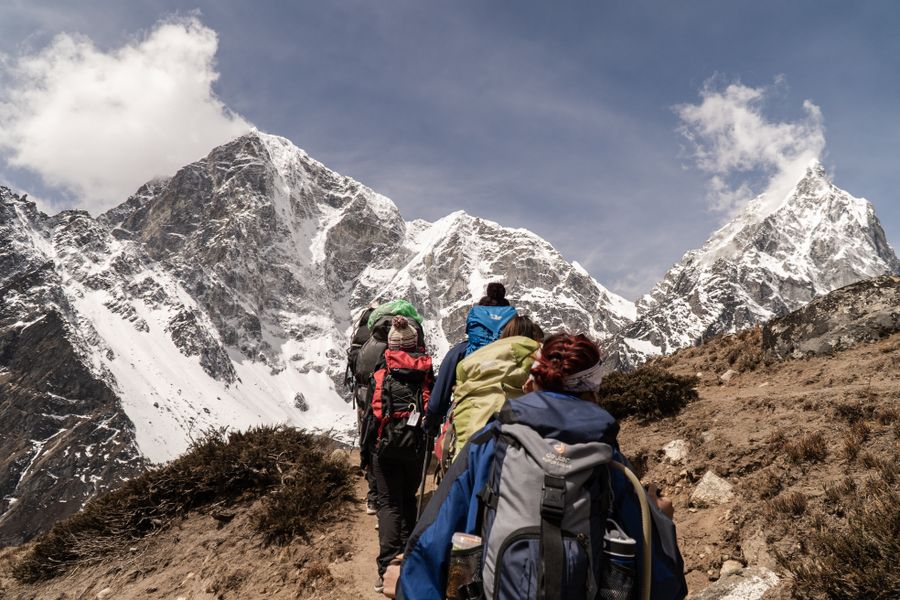
- We are a women-led company, owned and run by women. We also run the Annapurna Base Camp Trek, so our team knows the Sanctuary on foot as well as from the air.
- One price, with nothing to add at the airport. The conservation area permit, landing fees and hotel transfers are already in the USD 500.
- We find seats for small groups. If there are fewer than 4 of you, we try to put you with other travellers on the same morning, so you still pay the shared seat price (see section 9).
- We tell you the weather rule before you pay. You know in advance what happens to your money if the Sanctuary is in cloud.
Mountains you see from Annapurna Base Camp
| Mountain |
Height |
Where you see it |
First climbed |
| Annapurna I |
8,091 m |
At the landing, straight above you to the north |
1950, by Maurice Herzog and Louis Lachenal |
| Annapurna South |
7,219 m |
At the landing, to the south-west |
1964, by a Japanese team from Kyoto University |
| Hiunchuli |
6,441 m |
At the landing, beside Annapurna South |
1971, by an American team |
| Machhapuchhre (Fishtail) |
6,993 m |
At the landing, to the east, and the whole way up the gorge |
Never. It is sacred, and climbing is not permitted |
| Gangapurna |
7,455 m |
At the landing, to the north-east |
1965, by a German team |
| Annapurna III |
7,555 m |
At the landing, to the north-east |
1961, by an Indian team led by Mohan Singh Kohli |
| Baraha Shikhar (Annapurna Fang) |
7,647 m |
At the landing, beside Annapurna I |
1980, by an Austrian-led team. Climbed only a handful of times since |
| Gandharva Chuli |
6,248 m |
At the landing, beside Machhapuchhre |
2013, by Cosmin Andron and Cristina Pogăcean |
| Tent Peak (Tharpu Chuli) |
5,663 m |
At the landing, to the north-east |
A trekking peak, climbed from the Sanctuary |
| Dhaulagiri I |
8,167 m |
From the air, far to the west, on a clear morning |
1960, by a Swiss team |
At the landing the peaks surround you on every side. You see Dhaulagiri from the air on clear mornings, and haze or cloud can hide it.
Itinerary at a glance
| Time |
What happens |
Altitude |
| 6:00 am |
Hotel pickup in Lakeside |
820 m |
| 6:30 am |
Check-in, weighing and safety briefing at Pokhara Airport |
820 m |
| 6:50 am |
Take-off, 20 minutes up the Modi Khola gorge |
|
| 7:10 am |
Landing at Annapurna Base Camp, 20 to 30 minutes on the ground |
4,130 m |
| 7:40 am |
Return flight, 20 minutes |
|
| 8:00 am |
Landing at Pokhara Airport |
820 m |
| 8:30 am |
Back at your hotel |
820 m |
What the flight costs
USD 500 per person. The price is based on 4 passengers sharing one helicopter, so one full helicopter costs USD 2,000. A group of 4 that books together has the helicopter to itself.
Helicopter flights are paid in full when you book, because we pay the airline for your seat in advance. You can pay by bank transfer, by card, or in cash at our office in Lakeside. See our booking and payment terms for the details.
Price by group size
A shared flight goes once 4 seats are sold. If the seats haven't filled by 6 pm the evening before, we tell you and you choose: pay the difference and fly privately, move to another morning, or get a full refund.
If the weather says no
Flights into the Sanctuary only go when the pilot is satisfied with the visibility and wind at the landing site, and some mornings that doesn't happen. Here is what happens to your money:
| What happens |
What you get |
| The flight is cancelled for weather before take-off |
A free move to the next flyable morning, or a full refund. You choose |
| The pilot lands at Machhapuchhre Base Camp instead of ABC, and you agreed |
It counts as your tour. No refund |
| The pilot can't land anywhere and turns back after take-off |
Treated as a weather cancellation: a free move to another morning, or a full refund |
Keep a spare morning. Book the flight early in your stay in Pokhara, not on your last morning. Then a cloudy day only costs you a delay.
If you cancel
| When you cancel |
What you pay |
| More than 72 hours before the flight |
Nothing. Full refund, less any card fee |
| 24 to 72 hours before |
50% of the price |
| Less than 24 hours before, or you do not show up |
100% of the price |
Helicopter or trek which suits you?
| |
Helicopter tour |
Annapurna Base Camp Trek |
Annapurna Base Camp Short Trek |
| Time |
1.5 hours from check-in |
7 days from Lakeside |
5 days from Lakeside |
| Reach ABC |
In 20 minutes |
On day 3 |
Same route up, two days faster down |
| Fitness |
None |
Steady walking, 5 to 7 hours a day |
For fit, regular walkers |
| Altitude |
20 to 30 minutes at 4,130 m |
Gradual, over 3 days, with a night at 4,130 m |
As the 7-day trek |
| Price |
USD 500 a seat |
USD 475 |
USD 365 |
| Best for |
Short stays, families, older parents, a second Himalayan view after another trek |
Walkers who want Chhomrong, the forest gorge and sunrise at ABC |
Fit walkers short on days |