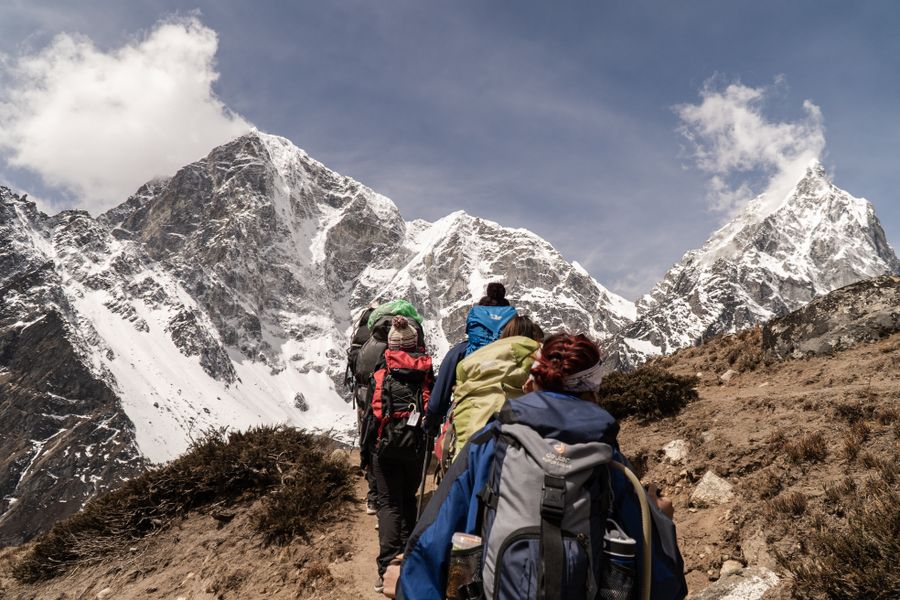
Kapuche Lake: what it is and why it is there
The name comes from Gurung: kah (ice), phu (tumbling down) and che (flat land). In other words, ice that tumbles down and settles on flat ground. That is exactly how the lake formed.
| Fact |
Detail |
| Location |
Kaski district, Gandaki Province, about 28.45° N, 84.11° E, above Sikles |
| Altitude |
About 2,450 m. Nepal's Department of Hydrology and Meteorology surveyed it at 2,423 m in 2022. Some agency websites say 2,546 m |
| Surface area |
0.114 km² (about 11 hectares) in the 2022 government survey, and still growing |
| Maximum depth |
34 m, measured in the same 2022 survey |
| Formed |
Since about 2001, when satellite images first showed ponds on the buried avalanche ice |
| Fed by |
Avalanches and meltwater from a snowfield at about 7,500 m between Annapurna II and IV, nearly 5,000 m above the lake |
| River |
One of the sources of the Madi river |
| Protected area |
Inside the Annapurna Conservation Area |
About the views. Kapuche sits so deep under its cliffs that you cannot see the big summits from the shore itself. You see the walls and the avalanche chutes. The views of Annapurna II, Annapurna IV and Lamjung Himal come from the air, on the way in and out.
Is Kapuche the lowest glacial lake in the world?
No. It is the lowest glacial lake in Nepal, and that is the claim the science supports. A 2023 study in the Journal of Mountain Science, "Evolution and bathymetry of glacial lake at the lowest elevation in Nepal Himalaya", measured the lake and placed it at about 2,450 m. New glacial lakes in Nepal usually form much higher, between 4,200 and 5,800 m, on bare moraine above the tree line. Kapuche lies about 2,000 m below that band, among forest and pasture.
Elsewhere in the world, glacial lakes form far lower. Jökulsárlón in Iceland, at the foot of the Breiðamerkurjökull glacier, lies at sea level. So the line "the lowest glacier lake in the world", which you will see on some websites, isn't true.
Some scientists also question whether Kapuche is a true glacial lake. Lakes like Tsho Rolpa and Imja Tsho sit behind the moraine walls of retreating glaciers. Kapuche formed as buried avalanche ice melted, and it is fed mainly by avalanches, so they call it an avalanche-fed lake.
| Lake |
Where |
Altitude |
Area |
| Kapuche |
Kaski, below Annapurna II |
about 2,450 m |
about 0.11 km² |
| Tsho Rolpa |
Rolwaling , Dolakha |
4,560 m |
about 1.6 km² |
| Imja Tsho |
Everest region |
about 5,010 m |
more than 1 km² |
The avalanche that made Kapuche famous
In January 2021 a group of young Nepali kayakers, including Kiran Shrestha, was camping by the lake when a huge avalanche broke loose from the cliffs above. They filmed it as a white cloud of powder snow poured down the face, crossed the lake and rolled over their camp. Nobody was hurt. The video spread around the world within days. A few weeks later it was shared again as footage of the Chamoli glacier disaster in India, and fact-checkers had to confirm that it showed Kapuche Lake in Nepal.
The group said they had heard several smaller avalanches in the days before. That is normal here. The lake exists because the cliffs above shed ice and snow all year, which is why the rules at the lake are strict.
Safety at the lake
Ice and snow can fall into the lake from above without warning. The people who monitor the lake for the Annapurna Conservation Area warn visitors about two things:
- Do not go onto the avalanche debris fan on the far side of the lake
- Do not go on the water. Boating is not allowed, because of falling ice
Stay on the near shore where the pilot lands you, and come back to the helicopter when called.
Sikles, the Gurung village below the lake
Sikles sits on a ridge at about 1,980 m, with Annapurna II and Lamjung Himal behind it, and is home to about 4,000 people. It is one of the oldest and largest Gurung settlements in Nepal, a tight village of stone houses with slate roofs. The Gurung people of these hills are known for their traditional dances and festivals, and many families have served in the British and Indian Gurkha regiments.
The Annapurna Conservation Area Project has an office in Sikles and has long promoted it as a model village for community-run tourism. The government has listed it among Nepal's 100 important tourist destinations, and by 2018 the village had 12 hotels and 15 homestays. Most Nepali visitors come by jeep for a night or two. From the helicopter you see the whole village on its ridge, with its terraced fields falling away to the Madi river.
The fullest account of the lake's history, published in the Nepali Times in 2024, was written by Hum Gurung, a conservationist from Sikles.
Add Kori Danda: two landings on one flight
Kori Danda is a high grass ridge at about 3,800 m above Sikles. It is the opposite of Kapuche. The lake sits deep in a bowl where you look up at cliffs and ice. Kori is an open ridge-top with the full panorama: Annapurna II, Lamjung Himal and Machhapuchhre, and on clear mornings peaks as far as Dhaulagiri and Manaslu.
The two landing sites are a few minutes apart by helicopter, so they combine well. The usual order is Kori first, while the morning is clearest, then down to Kapuche. Allow about 20 to 30 minutes of extra flying and ground time. Ask us for the combined price.
| |
Kapuche Lake |
Kori Danda |
| Altitude |
About 2,450 m |
About 3,800 m |
| What it is |
Glacial lake in an avalanche bowl |
Open grass ridge |
| What you see from the ground |
Cliffs, avalanche chutes and floating ice |
The Annapurna summits in a wide panorama |
| Best for |
Avalanches, the lake itself, children and older parents |
Big mountain views |
Kori Danda is also sold on its own as our Kori Danda Helicopter Tour.
Why book this flight with us
- A local office you can walk into. Visit us at 19 Street Lakeside, Pokhara-6, the day before your flight. Meet the team, ask your questions and pay in person.
- We are a women-led company, owned and run by women. We are based in Pokhara, and Sikles, Kapuche and Kori are part of the hill country we know.
- One price, with nothing to add at the airport. The conservation area permit, airport tax and hotel transfers are in the USD 400.
- We find seats for small groups. If there are fewer than 4 of you, we try to put you with other travellers on the same morning, so you still pay the shared seat price.
- We tell you the weather rule before you pay. You know in advance what happens to your money if the bowl is in cloud.
Mountains you will see
| Mountain |
Height |
Where you see it |
Did you know? |
| Annapurna II |
7,937 m |
From the air on the approach, directly above the lake |
First climbed on 17 May 1960 by Chris Bonington, Richard Grant and Ang Nyima Sherpa |
| Annapurna IV |
7,525 m |
From the air, beside Annapurna II. The snowfield between the two feeds the lake |
First climbed in 1955 by a German expedition |
| Lamjung Himal |
6,983 m |
From the air, to the east of the lake |
The south-eastern end of the Annapurna range, first climbed in 1974 |
| Machhapuchhre (Fishtail) |
6,993 m |
From the air, to the west, on take-off and on the way back |
Never officially climbed. It is sacred, and climbing it is not permitted |
Itinerary at a glance
| Time |
What happens |
Altitude |
| 6:30 am |
Hotel pickup in Lakeside |
820 m |
| 7:00 am |
Check-in, weighing and safety briefing at Pokhara Airport |
820 m |
| 7:20 am |
Take-off, 20 minutes north-east over Sikles |
|
| 7:40 am |
Landing beside Kapuche Lake, 20 to 30 minutes on the ground |
about 2,450 m |
| 8:10 am |
Return flight, 20 minutes |
|
| 8:30 am |
Landing at Pokhara Airport |
820 m |
| 8:45 am |
Back at your hotel |
820 m |
What the flight costs
USD 400 per person. The price is based on 4 passengers sharing one helicopter, so one full helicopter costs USD 1,600. A group of 4 that books together has the helicopter to itself.
Helicopter flights are paid in full when you book, because we pay the airline for your seat in advance. You can pay by bank transfer, by card, or in cash at our office in Lakeside. See our booking and payment terms for the details.
Price by group size
A shared flight goes once 4 seats are sold. If the seats haven't filled by 6 pm the evening before, we tell you and you choose: pay the difference and fly privately, move to another morning, or get a full refund.
If the weather says no
| What happens |
What you get |
| The flight is cancelled for weather before take-off |
A free move to the next flyable morning, or a full refund. You choose |
| The pilot can't get into the Kapuche bowl and turns back |
Treated as a weather cancellation: a free move to another morning, or a full refund |
| The pilot offers a different landing spot, and you agreed |
It counts as your tour. No refund |
Keep a spare morning. Book the flight early in your stay in Pokhara, not on your last morning.
If you cancel
| When you cancel |
What you pay |
| More than 72 hours before the flight |
Nothing. Full refund, less any card fee |
| 24 to 72 hours before |
50% of the price |
| Less than 24 hours before, or you do not show up |
100% of the price |