Landing on Kori Danda: what happens if the ridge is in cloud
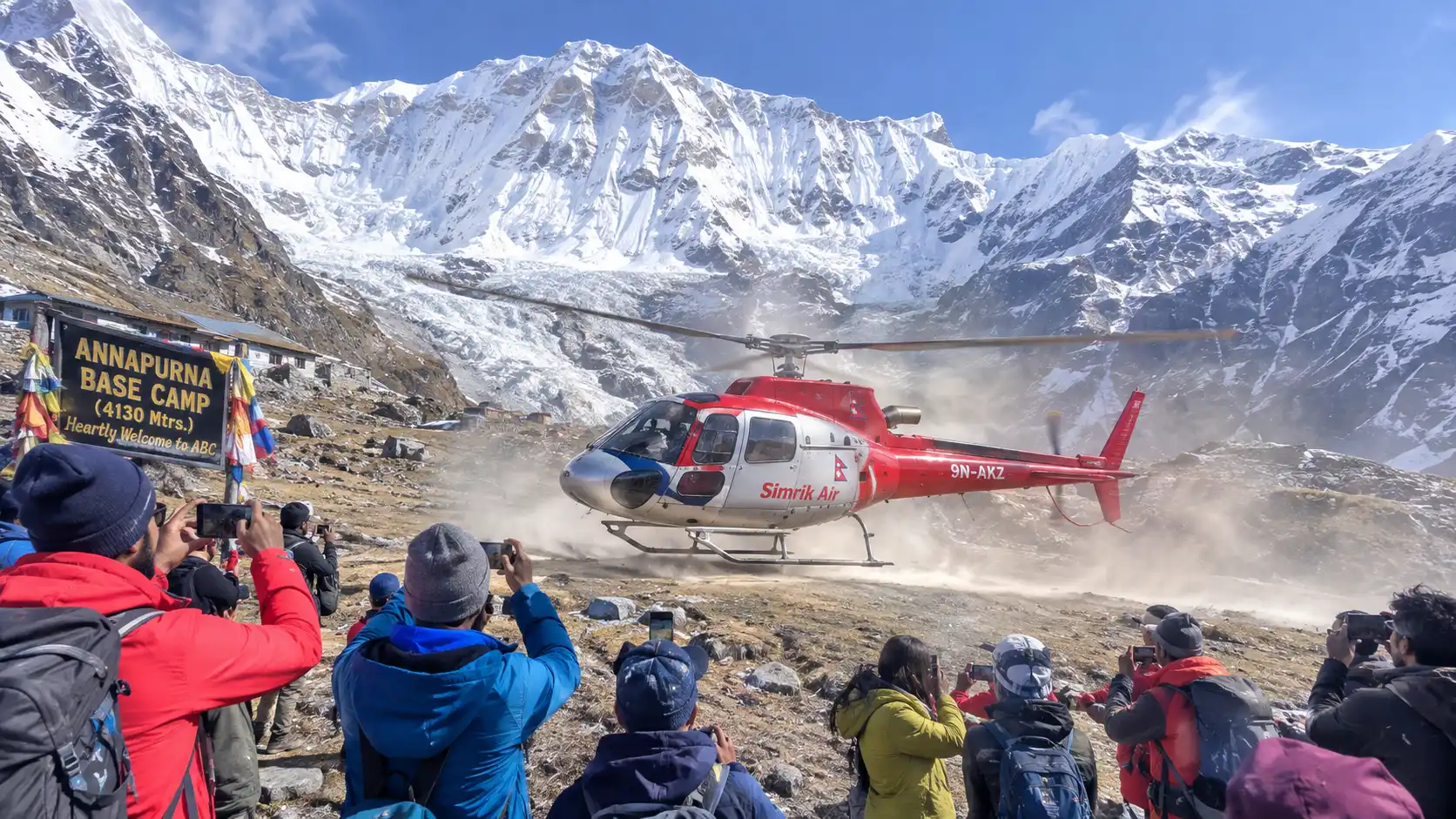
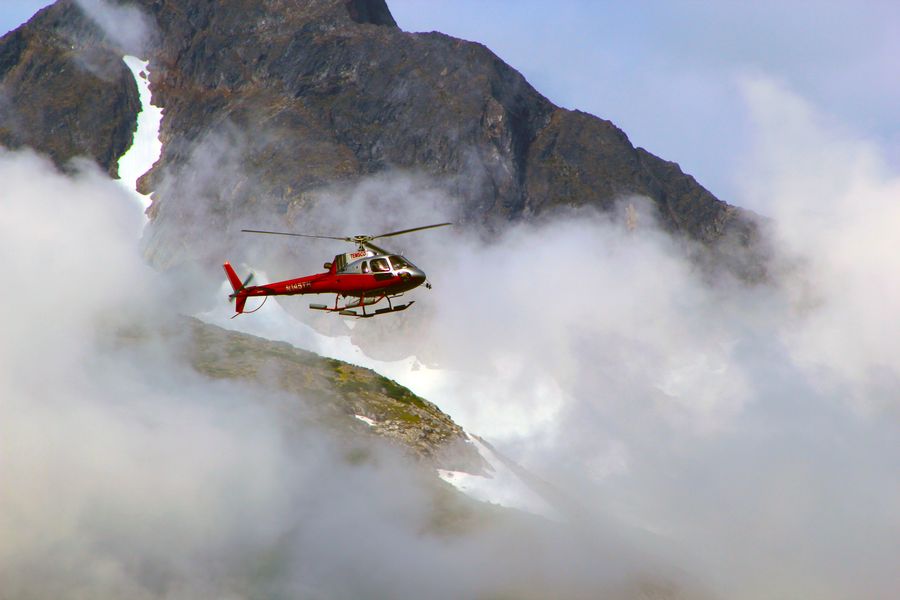
Kori Danda is a single, open ridge. The pilot only lands if the meadow is clear and the wind is safe. If cloud covers the ridge, the pilot may wait for it to lift or try again a little later. If it still won't clear, we fly you back and treat the morning as a weather cancellation (see section 9). We never land you somewhere else without asking you first.
Kori Danda: a high summer pasture on the Toni Hagen Trail
Kori is a kharka, a high summer pasture. Gurung and Ghale herders from the villages below bring their sheep and goats up to graze, and large Himalayan sheepdogs guard the flocks against leopards and bears. Below the ridge, at a pass called Deurali, travellers stack small stone cairns, a local custom for asking for good weather. A few simple, seasonal lodges serve trekkers on the ridge, but they are often closed, so don't count on buying anything.
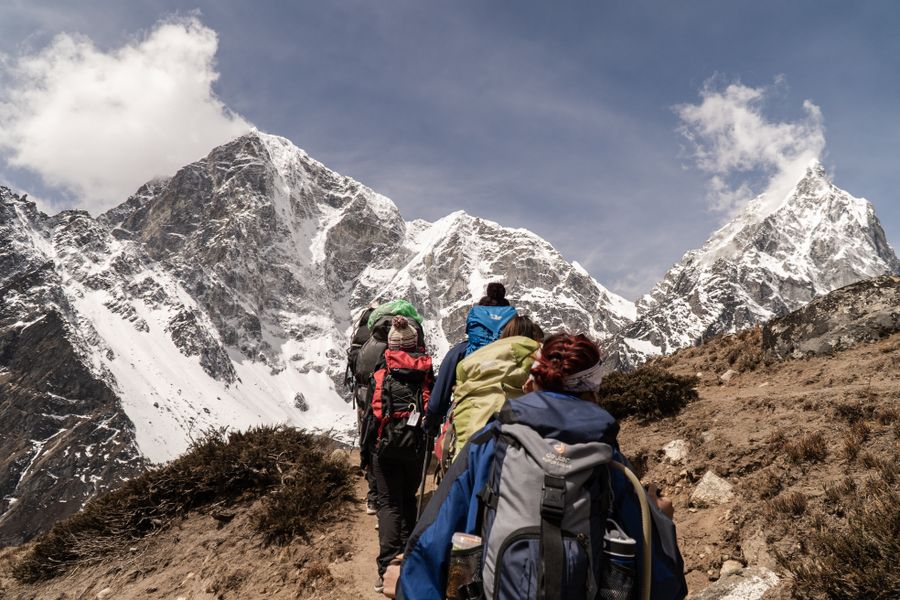
The walking route to Kori is part of the Toni Hagen Trail, named after the Swiss geologist who, between 1950 and 1961, became the first foreigner to travel the length and breadth of Nepal while making its first geological survey. Trekkers usually take two days from Sikles, via the village of Tasa, and it remains one of the least-walked routes in the Annapurna region.
Why the helicopter carries only 4 passengers
At 3,800 m the air is about 30% thinner than at sea level. A helicopter's rotor blades get less lift from thin air, and the engine produces less power, so the same helicopter can lift much less on the ridge than on the runway in Pokhara. Cold, dry mornings help, which is one more reason this flight leaves early.
That is why the pilot asks for every passenger's weight the evening before, weighs everyone again at check-in, and limits the cabin to 4 passengers. It is also why we ask you to leave large bags at your hotel. On the day, the pilot works out the safe load from the temperature and wind on the ridge.
Altitude and your body: what 40 minutes at 3,800 m means
The air pressure at 3,800 m is just under two-thirds of the pressure at sea level, so each breath brings in about a third less oxygen than you are used to. You climb nearly 3,000 m in 20 minutes with no time to adjust. Most people feel slightly breathless when they walk, and a few get a light headache or feel dizzy.
Real altitude sickness takes longer to develop. The US Centers for Disease Control and Prevention (CDC) says acute mountain sickness usually starts 2 to 12 hours after arriving at altitude, often during the first night. It also says day trips to altitude with a return to lower ground the same day are much easier on the body, because the body struggles most with thin air during sleep. On this tour you spend 30 to 40 minutes on the ridge and are back in Pokhara, at 820 m, within the hour.
On the ridge:
- Walk slowly and don't run, even for a photo
- Breathe steadily and drink a little water
- Tell the pilot at once if you feel faint, dizzy or very short of breath. There is oxygen on board, and the pilot can take you down within minutes
Talk to your doctor before you book if you have heart disease, a lung condition, high blood pressure, pulmonary hypertension or sickle cell trait, or if you are pregnant. The CDC notes that children are as sensitive to altitude as adults, so keep an eye on young children on the ridge.
Sikles, the village below the ridge
Sikles sits on a hillside at about 1,980 m and is home to about 4,000 people, most of them Gurung, with some Ghale families. It is one of the oldest and largest Gurung settlements in Nepal, a tight village of stone houses with slate roofs. The government has listed it among Nepal's 100 important tourist destinations, and by 2018 it had 12 hotels and 15 homestays, mostly used by Nepali visitors who come up by jeep. The Annapurna Conservation Area has one of its seven unit offices here.
Sikles is also the home village of Dr Chandra Prasad Gurung, one of Nepal's most important conservationists. He was the first director of the Annapurna Conservation Area Project from its start in 1986 until 1994, building the community-run model in which local people manage the forests they live beside, and he brought a 100 kW hydropower plant to Sikles in 1993. He died in 2006, with 23 others, in a helicopter crash in Taplejung that killed many of Nepal's leading conservationists. The village still remembers him as its mentor and guardian.
The forests below Kori: the clouded leopard's last outpost
The Hugu–Kori forests on the slopes below the ridge are one of the most remarkable wildlife areas near Pokhara. In 2012 a researcher's camera trap here photographed a clouded leopard, a rare and secretive forest cat, and the area is believed to be the westernmost limit of the species' range anywhere in the world. The same camera traps recorded common leopard, Himalayan black bear, leopard cat, large Indian civet and yellow-throated marten. You won't see these animals from the helicopter, but you fly over the forest that shelters them.
Add Kapuche Lake: two landings on one flight
Kapuche Lake, the lowest glacial lake in Nepal, lies a few minutes' flying from Kori, in the bowl below Annapurna II. The two sites are opposites. Kori is an open ridge-top with the full panorama of peaks. Kapuche sits deep in an avalanche bowl, where you look up at the cliffs and ice and can't see the summits at all. The usual order is Kori first, while the morning is clearest, then down to Kapuche. Allow about 20 to 30 minutes of extra flying and ground time. Ask us for the combined price.
| |
Kori Danda |
Kapuche Lake |
| Altitude |
About 3,800 m |
About 2,450 m |
| What it is |
Open grass ridge |
Glacial lake in an avalanche bowl |
| What you see from the ground |
The Annapurna summits in a wide panorama |
Cliffs, avalanche chutes and floating ice |
| Best for |
Big mountain views and space to walk |
Avalanches, the lake itself, children and older parents |
Kapuche Lake is also sold on its own as our Kapuche Lake Helicopter Tour.
Why book this flight with us
- A local office you can walk into. Visit us at 19 Street Lakeside, Pokhara-6, the day before your flight. Meet the team, ask your questions and pay in person.
- We are a women-led company, owned and run by women. We are based in Pokhara, and Kori and Sikles are part of the hill country we know.
- One price, with nothing to add at the airport. The conservation area permit, airport tax and hotel transfers are already in the USD 400.
- We find seats for small groups. If there are fewer than 4 of you, we try to put you with other travellers on the same morning, so you still pay the shared seat price (see section 9).
- We tell you the weather rule before you pay. You know in advance what happens to your money if the ridge is in cloud.
Mountains you will see
| Mountain |
Height |
Where you see it |
First climbed |
| Annapurna II |
7,937 m |
At the landing, straight ahead to the north |
1960, by Chris Bonington, Richard Grant and Ang Nyima Sherpa |
| Annapurna IV |
7,525 m |
At the landing, beside Annapurna II |
1955, by a German team |
| Lamjung Himal |
6,983 m |
At the landing, to the north and north-east |
1974, by Derrick Chamberlain and Phillip Neame |
| Machhapuchhre (Fishtail) |
6,993 m |
At the landing, to the west |
Never. It is sacred, and climbing is not permitted |
| Manaslu |
8,163 m |
At the landing and from the air, far to the east, on clear mornings |
1956, by a Japanese team |
Kori sees the Annapurnas from the east, so the skyline is different from Pokhara's. Annapurna II and IV are the big faces here, not Annapurna South and Annapurna I. Lamjung Himal is the south-eastern end of the whole Annapurna range. Manaslu needs a clear morning, and haze can hide it.
Itinerary at a glance
| Time |
What happens |
Altitude |
| 6:15 am |
Hotel pickup in Lakeside |
820 m |
| 6:45 am |
Check-in, weighing and safety briefing at Pokhara Airport |
820 m |
| 7:15 am |
Take-off, 20 minutes north-east over Sikles |
|
| 7:35 am |
Landing on Kori Danda, 30 to 40 minutes on the ground |
about 3,800 m |
| 8:15 am |
Return flight, 20 minutes |
|
| 8:45 am |
Landing at Pokhara Airport |
820 m |
| 9:15 am |
Back at your hotel |
820 m |
What the flight costs
USD 400 per person. The price is based on 4 passengers sharing one helicopter, so one full helicopter costs USD 1,600. A group of 4 that books together has the helicopter to itself.
Helicopter flights are paid in full when you book, because we pay the airline for your seat in advance. You can pay by bank transfer, by card, or in cash at our office in Lakeside. See our booking and payment terms for the details.
Price by group size
A shared flight goes once 4 seats are sold. If the seats haven't filled by 6 pm the evening before, we tell you and you choose: pay the difference and fly privately, move to another morning, or get a full refund.
Kori is a less common flight than Annapurna Base Camp, so shared seats fill more slowly. If you are 1 to 3 people, book a few days ahead, so we have time to find the other passengers.
If the weather says no
| What happens |
What you get |
| The flight is cancelled for weather before take-off |
A free move to the next flyable morning, or a full refund. You choose |
| The pilot can't land on Kori and turns back |
Treated as a weather cancellation: a free move to another morning, or a full refund |
| The pilot offers a different landing spot, and you agreed |
It counts as your tour. No refund |
Keep a spare morning. Book the flight early in your stay in Pokhara, not on your last morning. Then a cloudy day only costs you a delay.
If you cancel
| When you cancel |
What you pay |
| More than 72 hours before the flight |
Nothing. Full refund, less any card fee |
| 24 to 72 hours before |
50% of the price |
| Less than 24 hours before, or you do not show up |
100% of the price |