Landing at North Base Camp: what happens if the gorge is in cloud
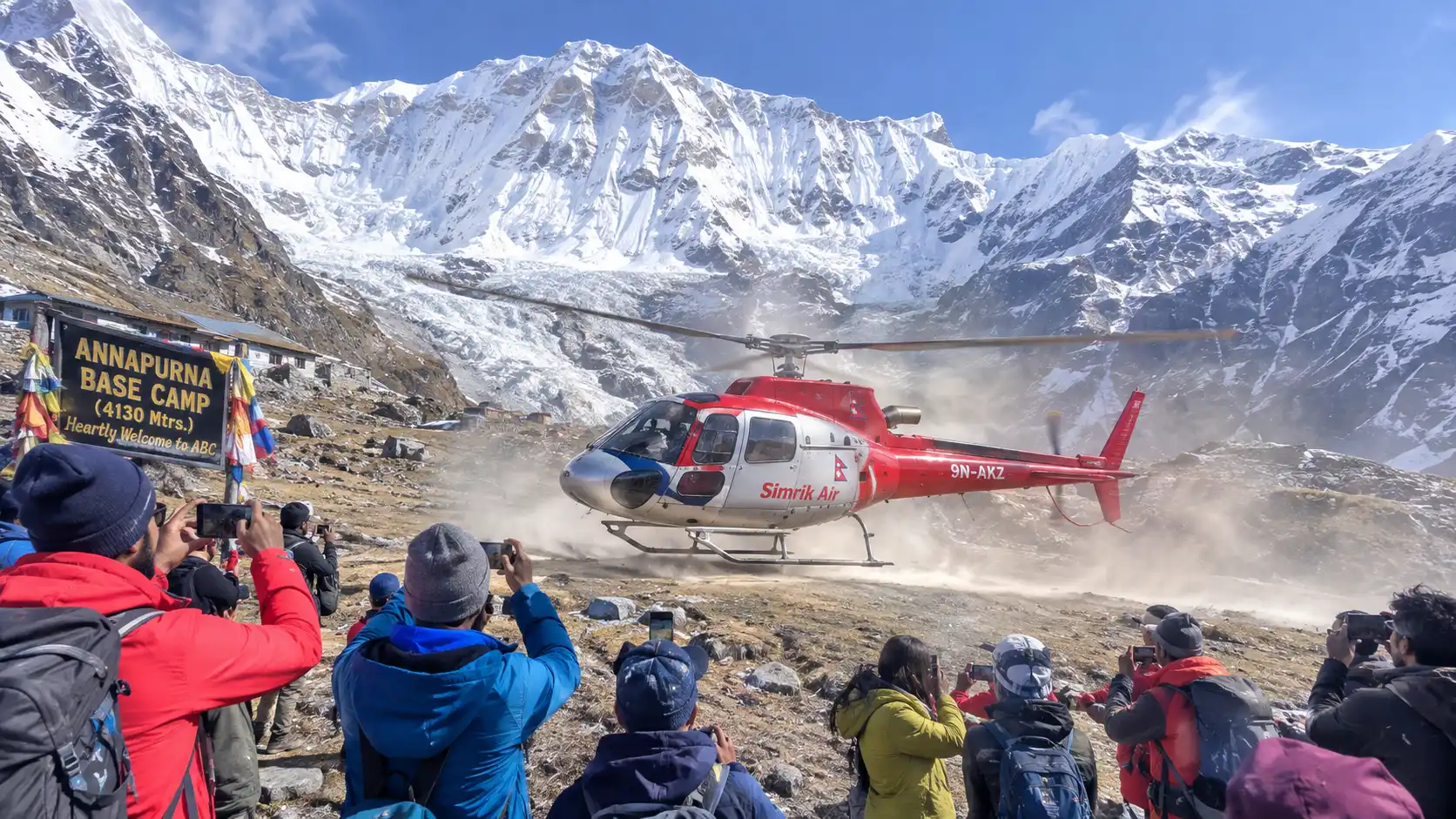
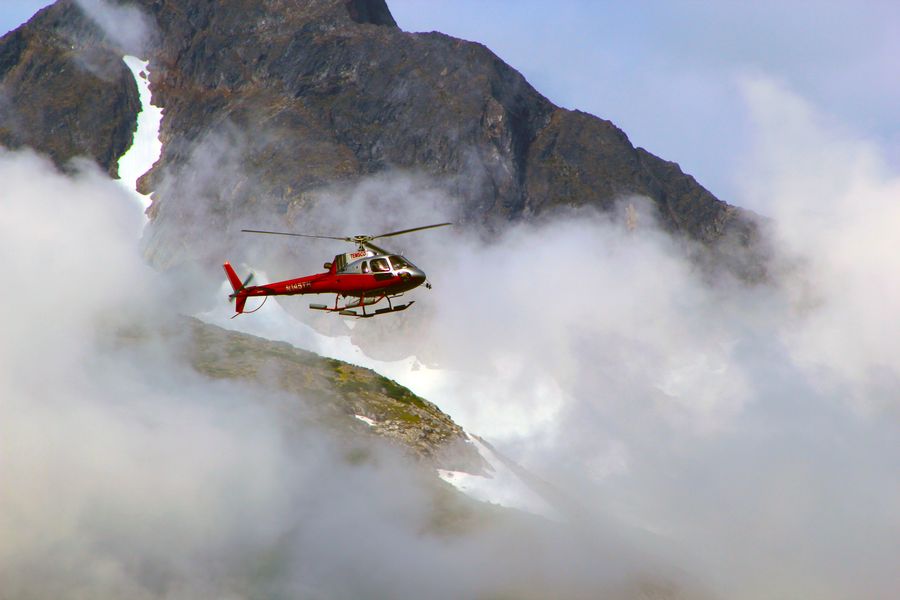
The Miristi Khola is a narrow gorge, and the pilot needs to see all the way in. The pilot only goes in if the gorge and the basin are clear. If they aren't, we fly you back and treat the morning as a weather cancellation (see section 9). We never land you somewhere else without asking you first.
Annapurna 1950: the first 8,000 m summit, step by step
Annapurna I is the tenth-highest mountain on Earth, at 8,091 m. In 1949 Nepal gave the French Alpine Club the first mountaineering permit it had granted in more than a century, for either Dhaulagiri or Annapurna. The team, led by Maurice Herzog, arrived knowing almost nothing about either mountain, with a survey map so wrong that whole valleys were missing.
| Date, 1950 | What happened |
|---|
| 17 April | The team first sees Dhaulagiri from the Kali Gandaki. It looks unclimbable |
| April | Marcel Schatz and Jean Couzy scout the Miristi Khola , drop about 900 m into the gorge and reach the foot of Annapurna. Their route is the one the expedition later uses, and the one you fly today |
| Early May | Herzog, Gaston Rébuffat and Marcel Ichac search to the north and find only the "Great Barrier" of the Nilgiri peaks, still with no sight of Annapurna |
| 14 May | At Tukuche , with the monsoon close, Herzog chooses Annapurna |
| 19 to 31 May | Base camp on the North Annapurna Glacier at about 4,400 m, then five higher camps up the north face, the last above an ice cliff called the Sickle |
| 3 June, 2 pm | Herzog and Louis Lachenal reach the summit, the first time anyone has climbed an 8,000 m peak |
| 4 to 7 June | On the descent Herzog loses his gloves, Lachenal falls into a crevasse, the summit pair and their rescuers spend a night in a snow cave, and an avalanche sweeps Herzog's rope team about 150 m |
| June to July | The monsoon arrives and washes away the bridge over the Miristi Khola , so the team climbs back out over the Nilgiri ridge, carrying Herzog and Lachenal |
The Maurice Herzog Trail
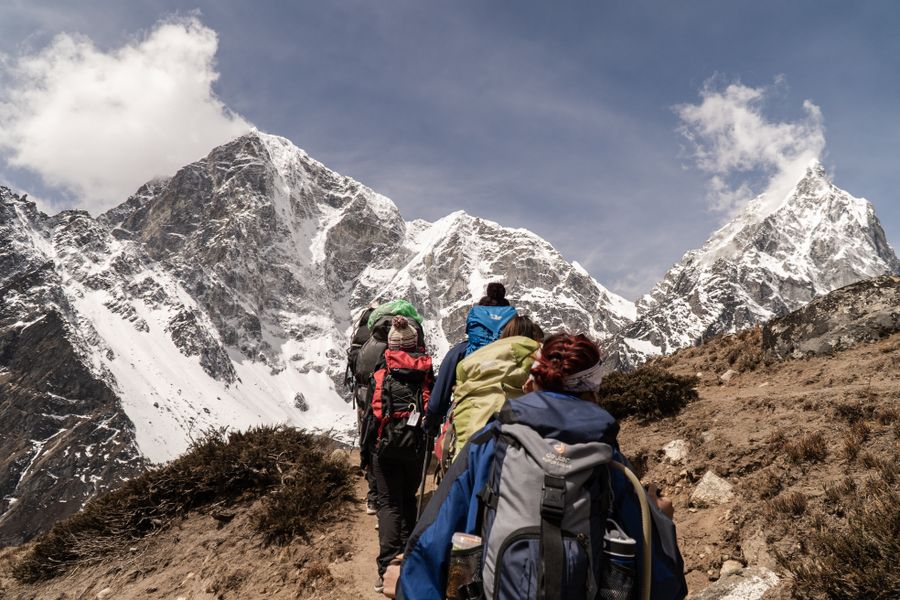
The walking route into the Miristi Khola is now called the Maurice Herzog Trail. It has been open to trekkers since 2020–21, and until a few years ago the valley was almost empty. The trail starts at Humkhola, two hours by road from Narchyang, where Annapurna Rural Municipality has built a 57 m suspension bridge to replace a shaky wooden crossing. Simple lodges and tent hotels now stand along the way.
Pancha Kunda: a sacred lake that is growing fast
Pancha Kunda, also called Narchyang Lake, lies near the base camp at about 4,050 m, at the foot of Annapurna I, Annapurna Fang, Tilicho Peak and Nilgiri. Sherpas call it Dikicho, the "frozen lake". Its Nepali name means "five ponds", from the five separate pools local people once saw here. Today they have joined into one lake.
It is growing quickly. Data from ICIMOD, the mountain research centre in Kathmandu, show the lake at about 0.04 km² in 2013 and about 0.39 km² in 2025, close to ten times larger in twelve years, as the glacier above it melts. Some local people argue the lake has deepened more than it has spread. No detailed on-site study has yet been made, and Annapurna Rural Municipality has asked the federal government for one.
The lake is sacred. A Shiva temple stands near its shore, families perform pind daan for their ancestors here, and a nearby hill is named after the sage Kaga Bhusundi. The Miristi Khola that drains the lake joins the Kali Gandaki at Narchyang, where its water also feeds three hydropower projects with a combined 152 MW.
Narchyang: the village at the mouth of the gorge
Narchyang is a farming village of about 1,500 people above the Kali Gandaki, about 100 km north-west of Pokhara. Most of its people are Magar, many of them from the Pun Magar clans, with Gurung and other families too. It sits below Dhaulagiri, Nilgiri and Annapurna I, and is known for the Narchyang waterfall, said to fall about 300 m, and for its community homestays. Many young people from the village work abroad. Building the new trail bridge at Humkhola gave work to more than 1,200 local people, and the trail now brings trekkers through the village.
Why the helicopter carries only 4 passengers
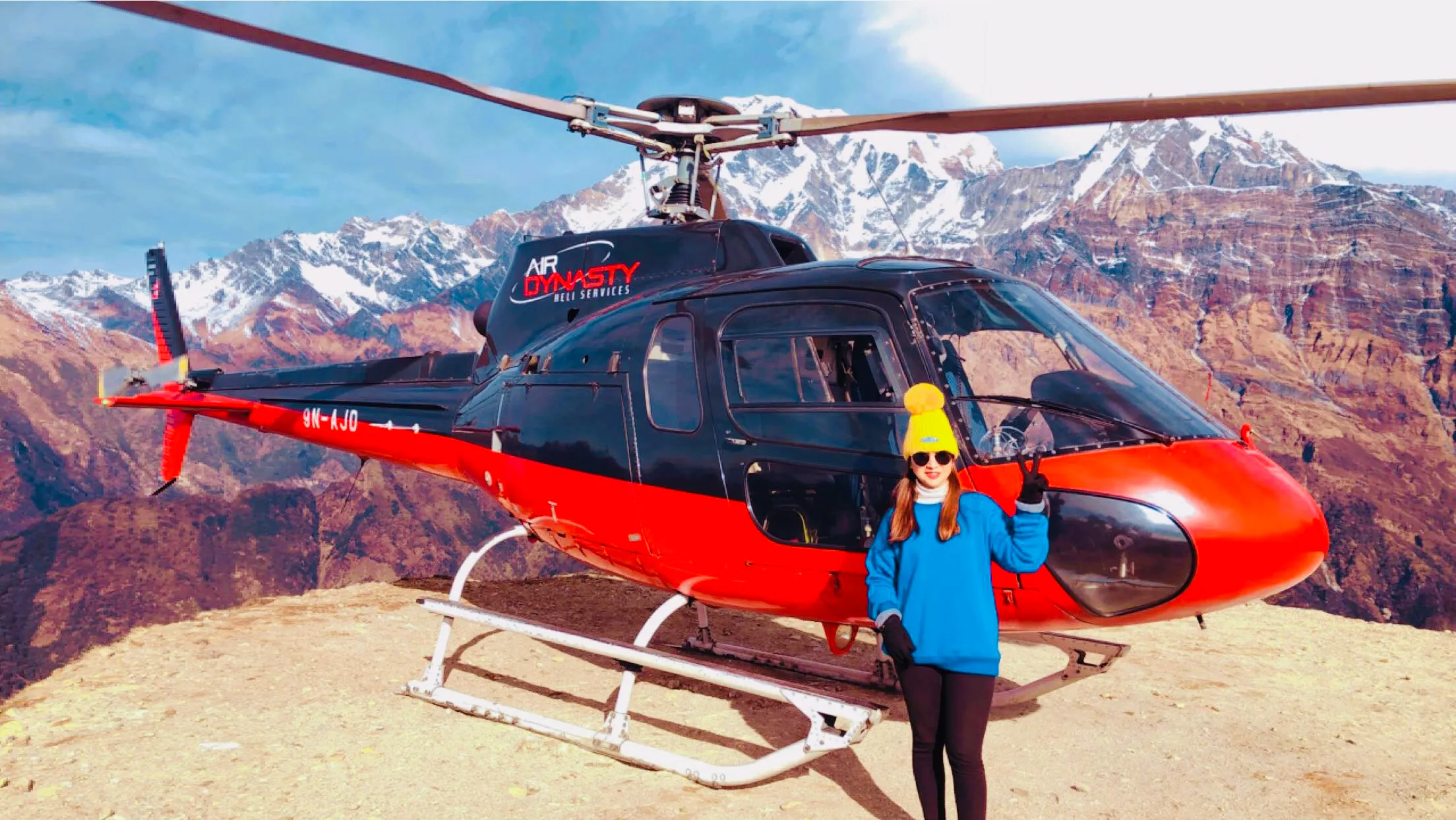
At 4,190 m the air is about a third thinner than at sea level. A helicopter's rotor blades get less lift from thin air, and the engine produces less power, so the same helicopter can lift far less in the basin than on the runway in Pokhara. Cold, dry mornings help, which is one more reason this flight leaves so early.
That is why the pilot asks for every passenger's weight the evening before, weighs everyone again at check-in, and limits the cabin to 4 passengers. It is also why we ask you to leave large bags at your hotel. On the day, the pilot works out the safe load from the temperature and wind in the basin.
Altitude and your body: what 30 minutes at 4,190 m means
The air pressure at 4,190 m is about 60% of the pressure at sea level, so each breath brings in a little over half the oxygen you are used to. You climb nearly 3,400 m in half an hour with no time to adjust, and you will notice it. Most people feel slightly breathless when they walk, and some get a light headache or feel dizzy.
Real altitude sickness takes longer to develop. The US Centers for Disease Control and Prevention (CDC) says acute mountain sickness usually starts 2 to 12 hours after arriving at altitude, often during the first night. It also says day trips to altitude with a return to lower ground the same day are much easier on the body, because the body struggles most with thin air during sleep. On this tour you spend about half an hour at 4,190 m and are back in Pokhara, at 820 m, within the hour.
At the base camp:
- Walk slowly and don't run, even for a photo
- Breathe steadily and drink a little water
- Tell the pilot at once if you feel faint, dizzy or very short of breath. There is oxygen on board, and the pilot can take you down within minutes
Talk to your doctor before you book if you have heart disease, a lung condition, high blood pressure, pulmonary hypertension or sickle cell trait, or if you are pregnant. The CDC notes that children are as sensitive to altitude as adults, so keep an eye on young children at the landing.
Why book this flight with us
- A local office you can walk into. Visit us at 19 Street Lakeside, Pokhara-6, the day before your flight. Meet the team, ask your questions and pay in person.
- We are a women-led company, owned and run by women. We also run the Annapurna North Base Camp Trek, so our team knows this valley on foot.
- One price, with every fee inside it. The conservation area permit, the Annapurna Rural Municipality tax, the landing fee, airport tax and hotel transfers are in the USD 700.
- We find seats for small groups. If there are fewer than 4 of you, we try to put you with other travellers.
- We tell you the weather rule before you pay. You know in advance what happens to your money if the gorge is in cloud.
Mountains you will see
| Mountain | Height | Where you see it | First climbed |
|---|
| Annapurna I | 8,091 m | At the landing, the north face directly above you | 1950, by Maurice Herzog and Louis Lachenal |
| Annapurna Fang (Baraha Shikhar) | 7,647 m | Around the basin, beside Annapurna I | 1980, by an Austrian-led team |
| Tilicho Peak | 7,134 m | To the north-east, the high point of the "Great Barrier" | 1978, by a French team |
| Nilgiri North | 7,061 m | To the north of the basin | 1962, by a Dutch expedition led by Lionel Terray, a member of the 1950 Annapurna team |
| Nilgiri South | 6,839 m | To the north of the basin | 1978, by a Japanese team |
| Dhaulagiri I | 8,167 m | Across the Kali Gandaki to the west, from the air and on clear mornings from the landing | 1960, by a Swiss team |
| Annapurna South and Hiunchuli | 7,219 m and 6,441 m | From the air on the way out, on your right | 1964 and 1971 |
| Machhapuchhre (Fishtail) | 6,993 m | Behind you on take-off from Pokhara | Never. It is sacred, and climbing is not permitted |
Itinerary at a glance
| Time | What happens | Altitude |
|---|
| 5:45 am | Hotel pickup in Lakeside | 820 m |
| 6:15 am | Check-in, weighing and safety briefing at Pokhara Airport | 820 m |
| 6:45 am | Take-off, 25 to 30 minutes via the Kali Gandaki and the Miristi Khola | |
| 7:15 am | Landing at North Base Camp, 20 to 30 minutes on the ground | about 4,190 m |
| 7:40 am | Return flight, 25 to 30 minutes | |
| 8:10 am | Landing at Pokhara Airport | 820 m |
| 8:45 am | Back at your hotel | 820 m |
What the flight costs
USD 700 per person. The price is based on 4 passengers sharing one helicopter, so one full helicopter costs USD 2,800. A group of 4 that books together has the helicopter to itself.
Helicopter flights are paid in full when you book, because we pay the airline for your seat in advance. You can pay by bank transfer, by card, or in cash at our office in Lakeside. See our booking and payment terms for the details.
Price by group size
A shared flight goes once 4 seats are sold. If the seats haven't filled by 6 pm the evening before, we tell you and you choose: pay the difference and fly privately, move to another morning, or get a full refund.
Few travellers know this flight exists, so shared seats fill slowly. If you are 1 to 3 people, book several days ahead, or consider flying privately.
If the weather says no
| What happens | What you get |
|---|
| The flight is cancelled for weather before take-off | A free move to the next flyable morning, or a full refund. You choose |
| The pilot can't get into the Miristi Khola and turns back | Treated as a weather cancellation: a free move to another morning, or a full refund |
| The pilot offers a different landing spot, and you agreed | It counts as your tour. No refund |
Keep a spare morning. Book the flight early in your stay in Pokhara, not on your last morning.
If you cancel
| When you cancel | What you pay |
|---|
| More than 72 hours before the flight | Nothing. Full refund, less any card fee |
| 24 to 72 hours before | 50% of the price |
| Less than 24 hours before, or you do not show up | 100% of the price |