Your hour at Muktinath: a darshan guide
An hour goes quickly once you include the walk. This is how most pilgrims use it:
| Minutes | What to do |
|---|
| 0 to 20 | Walk from the helipad up through Ranipauwa to the temple gate, or ride a horse |
| 20 to 25 | Remove your shoes at the main shrine. Darshan of Lord Vishnu as Muktinarayan. Photography of the deity and inside the shrine is not allowed |
| 25 to 35 | The 108 water spouts (Muktidhara) run around the back of the temple. Many pilgrims run under all 108, then dip in the two kunds in front. The water is ice cold |
| 35 to 40 | Jwala Mai , the small temple a minute's walk away, where a natural-gas flame burns from the ground |
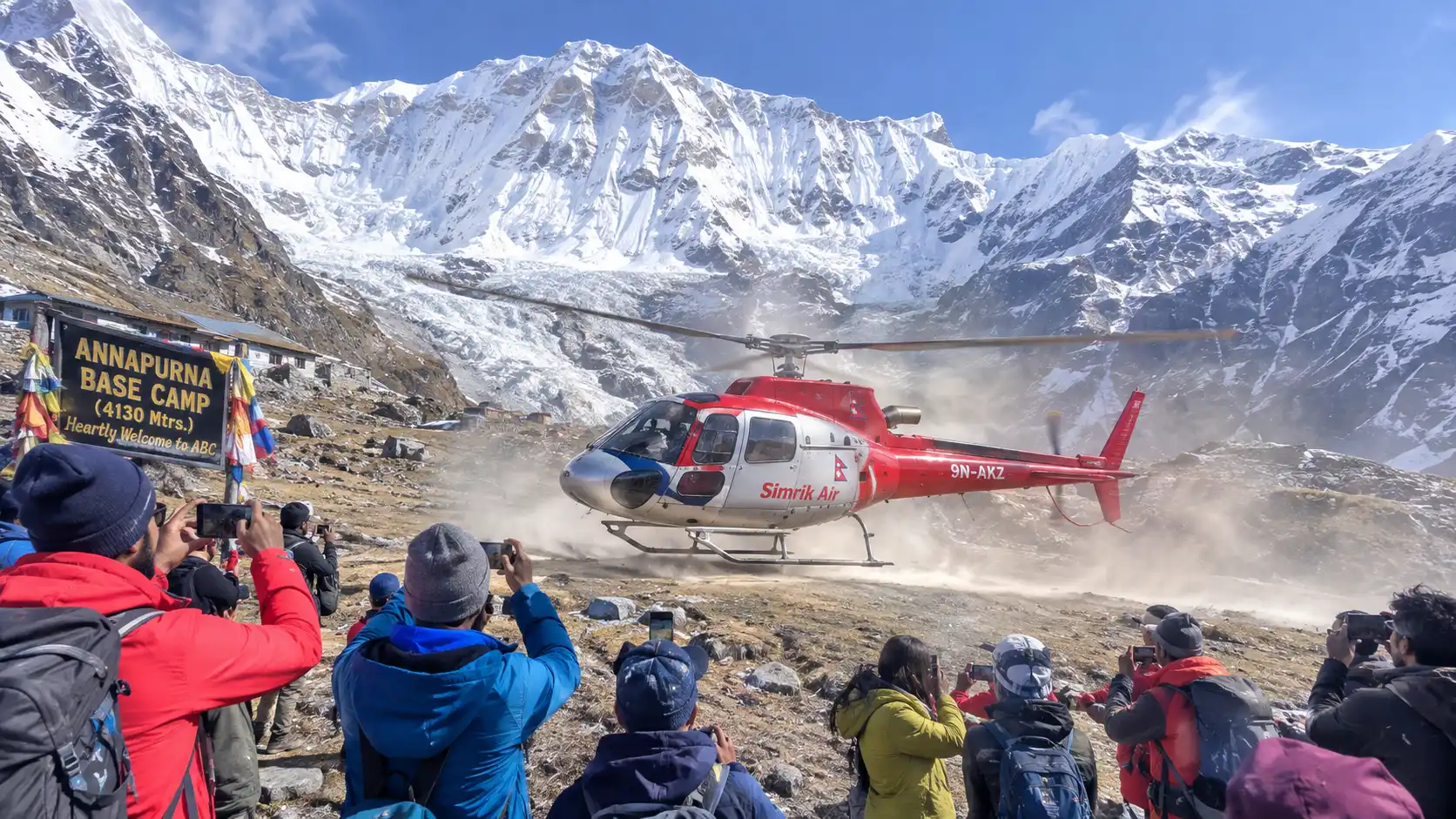
| 40 to 60 | Walk back down to the helipad. The pilot will not wait long, because the valley wind is building |
If you plan to bathe under the spouts, wear clothes you can get wet under your jacket, and bring a towel and a full change of clothes in a small bag. There is very little time to dry off, and the helicopter cabin is cold.
For puja: priests at the temple can perform a puja for you. Bring Nepali rupees in cash for the puja and for donations. If you want us to arrange a priest in advance, tell us when you book.
Muktinath temple: history and meaning
Muktinath means "Lord of Liberation". The main temple is a small pagoda in the style of the Kathmandu valley temples, and it houses Lord Vishnu as Muktinarayan. The present building dates from about 1815, when it was rebuilt under Queen Subarna Prabha, according to a bronze plaque inside the temple. The site itself is far older. Muktinath is praised in the Gandaki Mahatmya of the Vishnu Purana and is counted among the Char Dham of Nepal.
For Vaishnavas it is one of the 108 Divya Desam, the holy abodes of Vishnu praised by the Tamil Alvar saints between the 7th and 9th centuries. Periyalvar praised Vishnu here as "Salagramamudaiya Nambi", the Lord of Salagramam. Thirumangai Alvar could not reach the temple, so he sang ten verses towards it from the nearest place he could get to. Muktinath is also one of the eight Svayam Vyakta Kshetras, where Vishnu is believed to have appeared by himself, without being carved or installed.
For Shaktas, Muktinath is a Shakti Peeth, where the head of the goddess Sati is said to have fallen. Here she is worshipped as Gandaki Chandi, with Shiva as Chakrapani. Pilgrims also say all five elements meet here: water in the springs, fire in the flame, earth, air and sky.
The 108 water spouts and the two kunds
Behind the temple, 108 water spouts in the shape of cow heads (gaumukh) pour ice-cold spring water in a half-circle around the shrine. These are the Muktidhara, the "streams of liberation". The number 108 is sacred in both Hinduism and Buddhism, the same number as the beads on a prayer mala, and pilgrims believe that bathing under every spout washes away sin. In front of the temple are two ponds, usually called the Laxmi Kund and the Saraswati Kund, where pilgrims take a dip before darshan.
Jwala Mai: fire from water, earth and stone
A few minutes from the main temple is the small Jwala Mai temple, called Mebar Lhakhang or Dhola Mebar Gompa by Buddhists. It is built over an underground stream, and natural gas seeping up from below feeds small flames that burn without stopping. Tradition speaks of three eternal flames, one from the earth, one from the rock and one from the water, which is why both Hindus and Buddhists see this place as a miracle. Today usually only two of the flames are burning.
Chumig Gyatsa: Muktinath for Buddhists
For Tibetan Buddhists, Muktinath is Chumig Gyatsa, the "Hundred Waters", one of the 24 great tantric sites of the Himalaya. It is sacred to Avalokiteshvara, the bodhisattva of compassion, and is said to be a home of the 21 Taras and of the dakinis, the "sky dancers". Padmasambhava, the teacher who brought Buddhism to Tibet, is said to have meditated here on his way. Before he left, he is said to have made a statue of himself, which is kept in the Mharme Lhakhang, or Narsingh Gompa, north of the main temple. The shrines are cared for by Buddhist nuns, who by tradition descend from the women Padmasambhava taught. This is why you see a Hindu priest and a Buddhist nun side by side at the same shrine.
Shaligram: fossils from a vanished sea
The Kali Gandaki, the river you fly along, is the home of Shaligram stones. They are fossil ammonites, sea creatures that lived in the Tethys Sea before the Himalaya rose out of it. Hindus worship them as a natural, uncarved form of Lord Vishnu, offered tulsi leaves and water. Their colour and markings are read as different forms of Vishnu: black for Vishnu himself, white for Vasudeva, golden for Narasimha. The Padma Purana warns that buying or selling a Shaligram brings bad karma, and many stones sold to pilgrims are fakes, so be careful before you pay for one.
Kagbeni: where pilgrims honour their ancestors
On the way up you fly over Kagbeni, at 2,804 m, where the Jhong Khola from Muktinath meets the Kali Gandaki. It is often called one of the oldest villages in the Himalaya, and it stands at the start of the trail into Upper Mustang. For Hindus the confluence is Hansa Tirtha, a place to perform shraddha and pind daan for departed ancestors, especially during Pitru Paksha in September and October. The legend says two crows fighting over offerings fell into the confluence here and came out as swans. On a private flight, ask us whether a stop at Kagbeni can be added.
The Kali Gandaki gorge: one of the deepest on Earth
Between Dhaulagiri and Annapurna I, the Kali Gandaki river flows at about 2,520 m, 5,571 m below the summit of Annapurna I. Measured this way, from the river to the peaks on either side, it is often called the deepest gorge on Earth. For centuries it was the trade route between India and Tibet, and the Thakali traders of the upper valley, the Thak Khola, grew rich carrying salt, grain and wool along it. Today you fly through the middle of it, with peaks over 8,000 m on both sides of the helicopter.
Why Muktinath flights leave early
Every day a strong wind blows up the Kali Gandaki valley. Scientists who studied it found a daytime up-valley wind layer 1 to 2 km deep, which builds through the late morning, with only a weak flow back down the valley at night. That wind is why all scheduled flights to Jomsom run early in the morning, and why our pilot plans to be off the ground at Muktinath before it builds. It is also why the pilot will not wait long at the helipad.
Altitude and your body: what an hour at Muktinath means
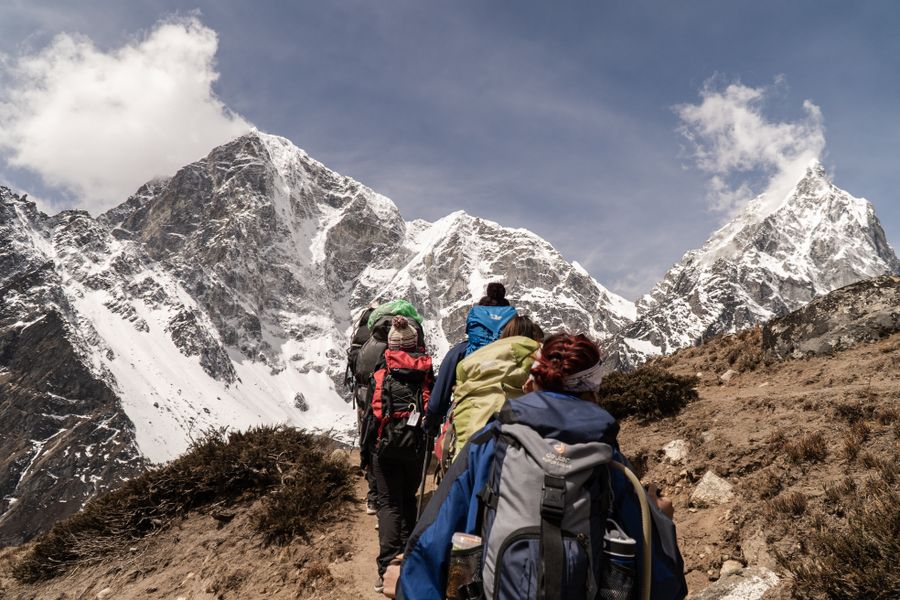
Muktinath sits at about 3,760 m, where the air pressure is about 63% of sea level. Sitting still you may notice nothing, but the uphill walk from the helipad to the temple will leave most people short of breath. Some people get a light headache or feel dizzy.
Real altitude sickness takes longer to develop. The US Centers for Disease Control and Prevention (CDC) says acute mountain sickness usually starts 2 to 12 hours after arriving at altitude, often during the first night. It also says day trips to altitude with a return to lower ground the same day are much easier on the body, because the body struggles most with thin air during sleep. On this tour you spend about an hour at Muktinath and sleep in Pokhara, at 820 m.
At Muktinath:
- Walk slowly, with plenty of short rests, and hire a horse if walking uphill is hard for you
- Don't rush between the spouts and the kunds
- Tell the pilot at once if you feel faint, dizzy or very short of breath. There is oxygen on board
Talk to your doctor before you book if you have heart disease, a lung condition, high blood pressure, pulmonary hypertension or sickle cell trait, or if you are pregnant.
Yartung: the horse festival at Ranipauwa
Each summer, usually around Janai Purnima in July or August, the villages around Muktinath celebrate Yartung, the festival of summer's end. Riders in their finest dress race horses uphill to Ranipauwa, and villagers sing and process to the temple. It falls in the monsoon, when flights are less reliable, so if you want to see it, keep several spare mornings.
Why book this flight with us
- A local office you can walk into. Visit us at 19 Street Lakeside, Pokhara-6, the day before your flight. Meet the team, ask your questions and pay in person.
- We are a women-led company, owned and run by women. We are based in Pokhara, the closest city to Muktinath, so you start where the flight starts.
- One price, with the permit included. The conservation area permit, airport tax and hotel transfers are in the USD 600.
- We check your documents the evening before, so nobody in your family is turned away at the airport for the wrong ID.
- We tell you the weather rule before you pay. You know in advance what happens to your money if the valley is closed.
Mountains and places you will see
| Mountain or place | Height | Where you see it |
|---|
| Dhaulagiri I | 8,167 m | On your left in the Kali Gandaki gorge, both ways |
| Annapurna I | 8,091 m | On your right in the gorge |
| Nilgiri North | 7,061 m | Ahead of you as you fly up the valley, above Jomsom |
| Tukuche Peak | 6,920 m | Above the valley, west of Jomsom |
| Thorong Peak | 6,144 m | Above Muktinath, beside the Thorong La |
| Machhapuchhre | 6,993 m | Behind you on take-off from Pokhara |
| Jomsom and Kagbeni | about 2,720 to 2,800 m | Below you on the way up |
| Thorong La pass | 5,416 m | Above Muktinath to the east, the high pass of the Annapurna Circuit |
Itinerary at a glance
| Time | What happens | Altitude |
|---|
| 6:00 am | Hotel pickup in Lakeside | 820 m |
| 6:30 am | Check-in, ID check, weighing and safety briefing at Pokhara Airport | 820 m |
| 7:00 am | Take-off, 45 minutes up the Kali Gandaki | |
| 7:45 am | Landing at Ranipauwa helipad, walk up to the temple | about 3,700 m |
| 8:00 to 8:30 am | Darshan, the 108 spouts, the kunds, Jwala Mai | about 3,760 m |
| 8:45 am | Return flight, 45 minutes | |
| 9:30 am | Landing at Pokhara Airport | 820 m |
| 10:00 am | Back at your hotel | 820 m |
What the flight costs
USD 600 per person. The price is based on 4 passengers sharing one helicopter, so one full helicopter costs USD 2,400. A family or group of 4 that books together has the helicopter to itself.
Helicopter flights are paid in full when you book, because we pay the airline for your seat in advance. You can pay by bank transfer, by card, or in cash at our office in Lakeside. See our booking and payment terms for the details.
Price by group size
A shared flight goes once 4 seats are sold. If the seats haven't filled by 6 pm the evening before, we tell you and you choose: pay the difference and fly privately, move to another morning, or get a full refund.
If the weather says no
| What happens | What you get |
|---|
| The flight is cancelled for weather or wind before take-off | A free move to the next flyable morning, or a full refund. You choose |
| The pilot can't reach Muktinath and turns back | Treated as a weather cancellation: a free move to another morning, or a full refund |
| The pilot lands somewhere else, for example Jomsom, and you agreed | It counts as your tour. No refund |
Keep a spare morning. Book the flight early in your stay in Pokhara, not on your last morning. Then a windy or cloudy day only costs you a delay.
If you cancel
| When you cancel | What you pay |
|---|
| More than 72 hours before the flight | Nothing. Full refund, less any card fee |
| 24 to 72 hours before | 50% of the price |
| Less than 24 hours before, or you do not show up | 100% of the price |