Where the helicopter lands: Mardi Himal Base Camp, Upper Viewpoint or High Camp
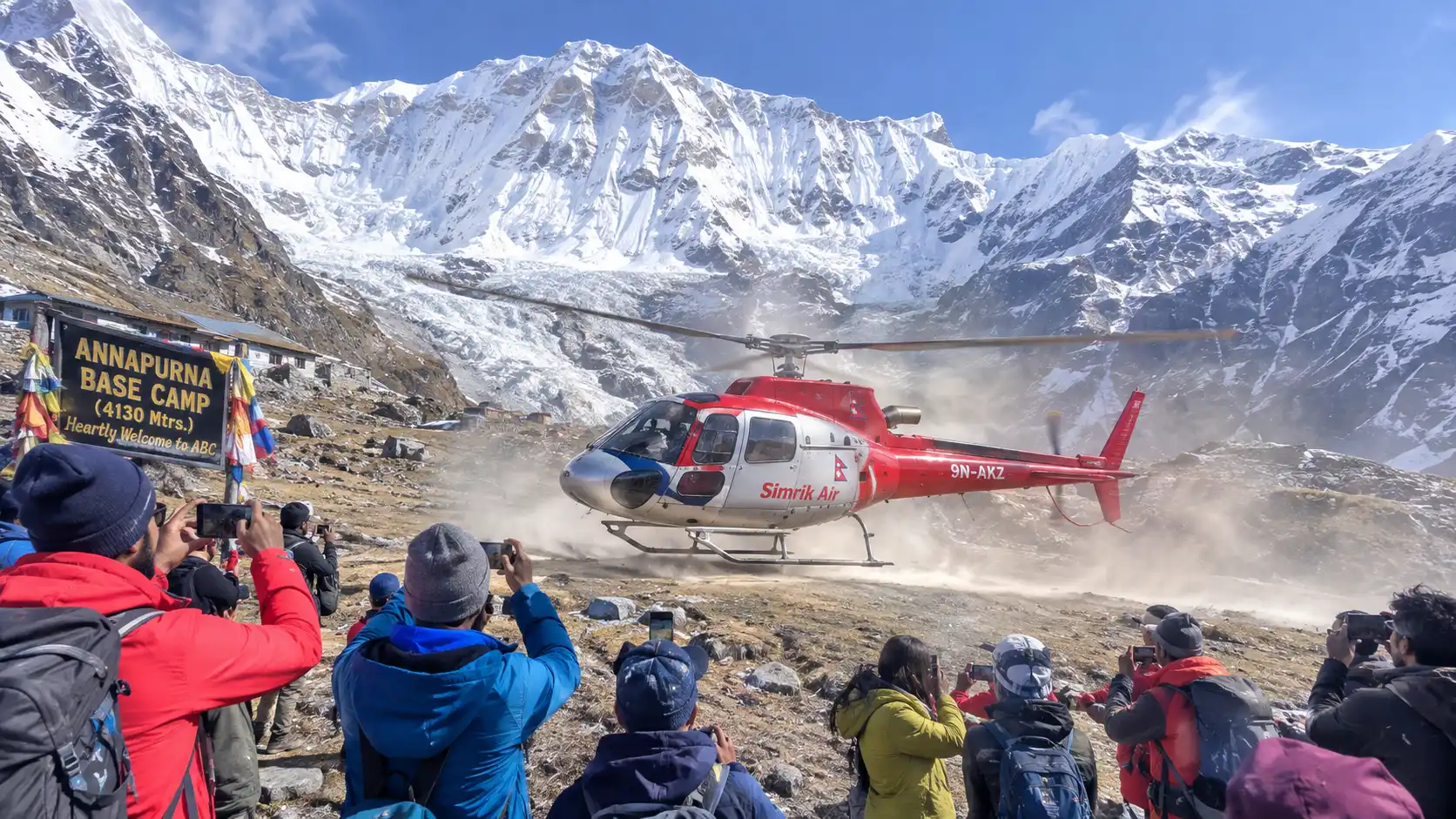
The helicopter can land at one of three spots on the Mardi Himal ridge. The pilot decides on the morning, from the cloud and wind at the landing site.
| Landing spot |
Altitude |
When the pilot uses it |
| Mardi Himal Base Camp |
4,500 m |
The plan for every flight. Used whenever cloud and wind allow |
| Mardi Himal Upper Viewpoint |
about 4,200 m |
When cloud sits on the base camp but the ridge below is clear. Trekkers come here for the classic close view of Machhapuchhre |
| Mardi Himal High Camp |
about 3,580 m |
When the upper ridge is in cloud. High Camp has trekking lodges and is the most sheltered spot on cold mornings |
If the base camp is closed in, we tell you before the pilot lands anywhere else. You can accept the lower landing, or fly straight back and treat the morning as a weather cancellation (see section 9). At 4,500 m the safety call always belongs to the pilot, so the landing spot is confirmed on the morning.
How often is the base camp clear? Our own trekking groups on this ridge reach the base camp about two days in three in autumn, and less often in spring, when cloud rises from the valleys by about 10 am. That is why this flight leaves early.
Check where any Mardi heli tour lands. Not every "Mardi Himal helicopter tour" goes to the base camp. Several operators land at High Camp, between about 3,550 and 3,850 m, as standard, almost 1,000 m lower. Before you book with anyone, ask which landing is the plan. Ours is the base camp at 4,500 m, with the two lower spots only as weather fallbacks.
Why the helicopter carries only 4 passengers
At 4,500 m the air is about 40% thinner than at sea level. A helicopter's rotor blades get less lift from thin air, and the engine produces less power, so the same helicopter can lift far less at the base camp than on the runway in Pokhara. Cold, dry mornings help, which is one more reason this flight leaves early. Warm or humid air reduces performance further.
That is why the pilot asks for every passenger's weight the evening before, weighs everyone again at check-in, and limits the cabin to 4 passengers. It is also why we ask you to leave large bags at your hotel. On the day, the pilot works out the safe load from the temperature and wind at the landing site.
Altitude and your body: what 30 minutes at 4,500 m means
The air pressure at 4,500 m is just under 60% of the pressure at sea level, so each breath brings in a little over half the oxygen you are used to. You climb nearly 3,700 m in 15 minutes with no time to adjust, and you will notice it. Most people feel slightly breathless when they walk, and some get a light headache or feel dizzy.
Real altitude sickness takes longer to develop. The US Centers for Disease Control and Prevention (CDC) says acute mountain sickness usually starts 2 to 12 hours after arriving at altitude, often during the first night. It also says day trips to altitude with a return to lower ground the same day are much easier on the body, because the body struggles most with thin air during sleep. On this tour you spend about 30 minutes at 4,500 m and are back in Pokhara, at 820 m, within the hour.
At the base camp:
- Walk slowly and don't run, even for a photo
- Breathe steadily and drink a little water
- Tell the pilot at once if you feel faint, dizzy or very short of breath. There is oxygen on board, and the pilot can take you down within minutes
Talk to your doctor before you book if you have heart disease, a lung condition, high blood pressure, pulmonary hypertension or sickle cell trait, or if you are pregnant. The CDC notes that children are as sensitive to altitude as adults, so keep an eye on young children at the landing.
Mardi Himal altitude: the ridge you fly over, from Pokhara to Base Camp
| Place |
Altitude |
What it is |
| Pokhara Airport |
820 m |
Where the flight starts |
| Kande |
1,770 m |
Where trekkers leave the road |
| Australian Camp |
2,060 m |
A popular viewpoint at the foot of the ridge |
| Forest Camp |
2,520 m |
A lodge stop in rhododendron and oak forest |
| Low Camp |
about 3,000 m |
A lodge stop near the top of the forest |
| Badal Danda |
about 3,200 m |
"Cloud ridge", where the trees end |
| Mardi Himal High Camp |
3,580 m |
The last lodges on the ridge |
| Mardi Himal Upper Viewpoint |
about 4,200 m |
The classic close view of Machhapuchhre |
| Mardi Himal Base Camp |
4,500 m (14,764 ft) |
Where the helicopter lands |
| Mardi Himal (summit) |
5,587 m (18,330 ft) |
The peak itself, a climbing peak |
| Machhapuchhre (Fishtail) |
6,993 m |
Directly above the landing |
Mountains you see on the Mardi Himal helicopter tour
| Mountain |
Height |
Where you see it |
First climbed |
| Machhapuchhre (Fishtail) |
6,993 m |
At the landing, towering right above you |
Never |
| Mardi Himal |
5,587 m |
At the landing, just ahead |
1961, by Basil Goodfellow |
| Annapurna South |
7,219 m |
At the landing, across the Modi Khola to the west |
1964, by a Japanese team from Kyoto University |
| Hiunchuli |
6,441 m |
At the landing, next to Annapurna South |
1971, by an American team |
| Annapurna I |
8,091 m |
From the air on a clear morning |
1950, the first 8,000 m peak ever climbed |
| Annapurna III |
7,555 m |
From the air, east of Machhapuchhre |
1961, by an Indian team led by Mohan Singh Kohli |
| Annapurna II |
7,937 m |
From the air, to the east |
1960, by Chris Bonington, Richard Grant and Ang Nyima Sherpa |
| Lamjung Himal |
6,983 m |
From the air, to the east |
1974 |
| Dhaulagiri I |
8,167 m |
From the air, far to the west |
1960, by a Swiss team |
| Manaslu |
8,163 m |
From the air, far to the east, on the clearest mornings |
1956, by a Japanese team |
The first four are close enough to fill your view at the landing site. You see the others from the air on clear mornings, and haze or cloud can hide them.
Machhapuchhre, the sacred mountain above the landing
Machhapuchhre means "fish tail" in Nepali. Seen from some angles, its summit splits into two points like the tail of a fish. From Pokhara it looks like a single sharp pyramid, which is why it is often called the Matterhorn of Nepal. It rises only about 25 km north of the city, which makes it look bigger from Pokhara than the higher Annapurnas behind it.
The mountain is sacred to the Gurung people of these valleys, and is said to be a home of the god Shiva. Only one team has ever tried to climb it. In 1957 a British expedition led by Jimmy Roberts sent Wilfrid Noyce and David Cox up the north ridge. King Mahendra had allowed the climb on condition that they did not stand on the summit. They turned back about 50 m below the top, and no climbing permit has been issued since. Its summit has never officially been reached.
From the base camp you are as close to Machhapuchhre as most people ever get. Mardi Himal is joined to it by a 5,200 m saddle, so the wall rising above the landing is Machhapuchhre itself.
A quiet ridge, opened in 2012
The ridge below Mardi Himal only opened as a trekking route in 2012, after a survey by the Trekking Agencies' Association of Nepal and the Annapurna Conservation Area Project, and lodges followed up to High Camp. It is still much quieter than Annapurna Base Camp, and as many Nepali trekkers walk it as foreigners.
The villages below the ridge
Two ways lead up to the Mardi ridge, and you see both from the air.
- On the west side, the road from Pokhara climbs to Kande, and a short walk leads to Australian Camp, a grassy shoulder at 2,060 m known locally as Thulo Kharka, "big pasture". Stories differ on how it got its English name. Just beyond is Dhampus, a Gurung village of stone and slate-roofed houses spread along its ridge.
- On the east side, the Gurung village of Lwang sits above the Mardi Khola valley. It is known for its tea gardens, planted at about 1,600 m, and for a community homestay programme that began in 2009. The conservation area has one of its offices here.
The Gurung people of these hills farm the terraces you see below you, and many Gurung families have served in the British and Indian Gurkha regiments.
The Annapurna Conservation Area, and what your permit pays for
The whole Mardi Himal ridge lies inside the Annapurna Conservation Area, Nepal's first and largest conservation area, at 7,629 km². It began in 1986 as a pilot project in Ghandruk and was made a conservation area by law in 1992. It is run by the National Trust for Nature Conservation, not by the army, and people continue to live, farm and own land inside it.
The area receives no regular government operating funds. Its work is paid for mainly by visitor entry fees and donors. So the conservation area permit included in your seat price goes back into the area: forest and wildlife protection, schools, health posts and local tourism. The area is home to about 1,226 flowering plants, 523 bird species and 105 mammals.
The Mardi Himal ridge: forest, flowers and wildlife
The flight up is a climb through every zone of the Nepal hills in fifteen minutes. Above Pokhara's rice terraces the ridge is covered in oak, rhododendron and bamboo forest. Rhododendron, lali gurans, is Nepal's national flower, and in March and April the forest below you turns red and pink. Around Badal Danda, at about 3,200 m, the trees stop. Above that the ridge is grass, juniper scrub and then bare rock and snow.
The forest is rich in birds. Scientists who surveyed the lower ridge in 2019, between 1,030 and 3,050 m, recorded more than 110 bird species, with the most at the forest edges in the middle of the ridge. Near High Camp trekkers sometimes see the Himalayan monal, the danphe, Nepal's national bird, with its shining blue-green and copper feathers. Langur monkeys and Himalayan tahr, a wild mountain goat, also live on the ridge. You won't see much wildlife from the helicopter, but you will see exactly where the forest gives way to the high mountain.
Why book this flight with us
- A local office you can walk into. Visit us at 19 Street Lakeside, Pokhara-6, the day before your flight. Meet the team, ask your questions and pay in person.
- We are a women-led company, owned and run by women. We also run the Mardi Himal Trek, so our team knows this ridge on foot as well as from the air.
- One price, with nothing to add at the airport. The conservation area permit, landing fees and hotel transfers are in the USD 300.
- We find seats for small groups. If there are fewer than 4 of you, we try to put you with other travellers on the same morning, so you still pay the shared seat price.
- We tell you the weather rule before you pay.
USD 300 per person. The price is based on 4 passengers sharing one helicopter, so one full helicopter costs USD 1,200. A group of 4 that books together has the helicopter to itself.
Helicopter flights are paid in full when you book, because we pay the airline for your seat in advance. You can pay by bank transfer, by card, or in cash at our office in Lakeside. See our booking and payment terms for the details.
Price by group size
A shared flight goes once 4 seats are sold. If the seats haven't filled by 6 pm the evening before, we tell you and you choose: pay the difference and fly privately, move to another morning, or get a full refund.
If the weather says no
| What happens |
What you get |
| The flight is cancelled for weather before take-off |
A free move to the next flyable morning, or a full refund. You choose |
| The pilot lands at the Upper Viewpoint or High Camp instead of the base camp, and you agreed |
It counts as your tour. No refund |
| The pilot can't land anywhere and turns back after take-off |
Treated as a weather cancellation: a free move to another morning, or a full refund |
Keep a spare morning. Book the flight early in your stay in Pokhara, not on your last morning.
If you cancel
| When you cancel |
What you pay |
| More than 72 hours before the flight |
Nothing. Full refund, less any card fee |
| 24 to 72 hours before |
50% of the price |
| Less than 24 hours before, or you do not show up |
100% of the price |
Helicopter or trek: which suits you?
| |
Helicopter tour |
Mardi Himal Trek |
| Time |
1.5 hours from check-in |
5 days from Lakeside |
| Highest point |
Base Camp, 4,500 m (weather allowing) |
Upper Viewpoint, 4,200 m, and Base Camp, 4,500 m, weather and pace allowing |
| Fitness |
None |
Steady walking for 5 to 7 hours a day |
| Altitude |
30 minutes at 4,500 m |
Gradual, over 3 days |
| Price |
USD 300 a seat |
USD 395 |
| Best for |
Short stays, families, older parents, a second Himalayan view after another trek |
Walkers who want the forest, the lodges and the sunrise from High Camp |