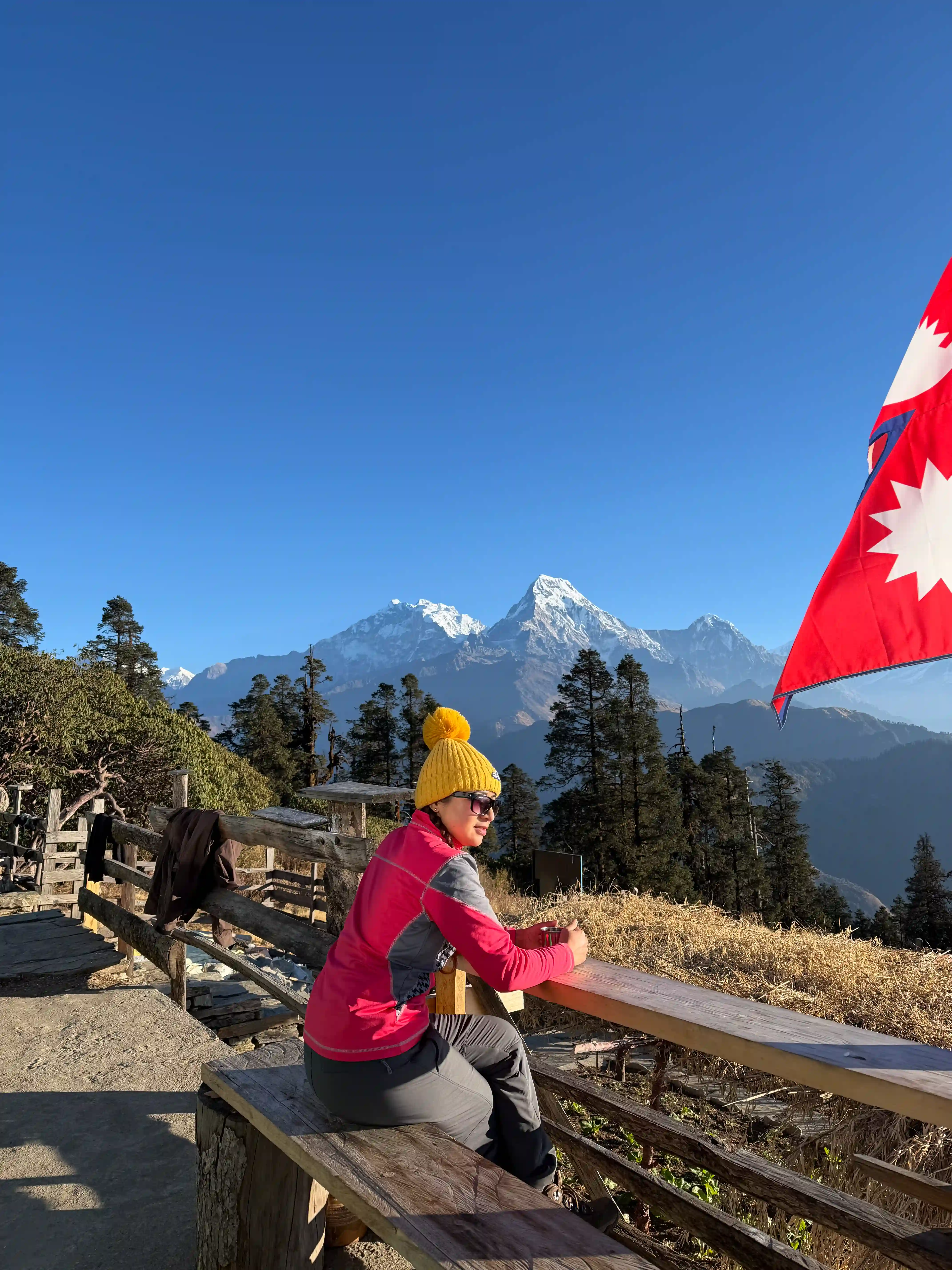
Trekking in Nepal for Beginners: From "Could I Do This?" to Your First Morning on the Trail
You have never done a multi-day trek, and Nepal sounds like the deep end. It isn't. Teahouse trekking is the gentlest way into the Himalaya: on the trails above Pokhara you sleep in a lodge every night, eat cooked meals, carry only a daypack, and walk with a licensed guide who has done the route many times. This guide takes you through it in the order you will live it: a fitness test at home, what a trekking day is really like, how to choose your first trek, altitude, training, paperwork, getting to the trailhead, packing and the mistakes to avoid.
Could you do it? A three-part test at home
If you can walk for three hours with hills, do it again the next day, and come down stairs without knee pain, you can do a first trek in Nepal. You don't need to be an athlete. What a trek asks for is steady walking, day after day, with a lot of stone steps up and down.
Try these three tests over one weekend, wearing the shoes and daypack you plan to trek in.
1. The long walk. Walk for three hours, about 10 to 12 km, on a route with some hills, carrying 4 to 5 kg (water, a jacket, lunch).
2. The second day. The next morning, walk again for two hours. This is the test that matters most, because on a trek every day follows another.
3. The stairs. Climb 20 floors of stairs at a steady pace, then walk back down. Notice how your knees feel on the way down.
What your results mean
|
How it went |
What it means for you |
|
All three felt fine |
You are ready for any of the first treks in part 3. Train for 8 weeks if you are aiming for Mardi Himal or Annapurna Base Camp. |
|
The walks were fine, the stairs were hard |
Start with Poon Hill over 4 days, which gives the climb to Ghorepani a whole day, and add stair work to your training. Bring trekking poles. |
|
You struggled on the long walk |
Follow the training plan in part 5 before you book a multi-day trek, or start with a day hike or the 3-day Sikles trek. |
Talk to your doctor first, and choose a lower first trek, if you have a heart or lung condition, high blood pressure that isn't under control, a recent operation or injury, you are pregnant, or you have had altitude sickness before. Sikles, which never goes above 1,980 m, and Poon Hill, where the highest night is 2,860 m, keep you lower than most treks.
One trekking day, hour by hour
A trekking day is simple: you walk in the morning, eat lunch on the trail, arrive in the afternoon and are in bed soon after dinner. Most days on our first treks have 4 to 8 hours of walking, with stops. Here is a typical day on an autumn trek in the Annapurna foothills.
|
Time |
What happens |
|
6:00 |
Wake up. The room is cold, so dress inside your sleeping bag. Pack your bag before breakfast. |
|
6:30 |
Breakfast in the dining room: porridge, Tibetan bread, eggs or pancakes, ordered the night before. Fill your water bottles with boiled or filtered water from the lodge. |
|
7:30 |
Start walking in your warm layers. Take one off after 20 minutes, before you start to sweat. |
|
7:30–11:30 |
The morning walk, about 3 to 4 hours. Your guide sets a slow, steady pace and stops for water, photos and a tea break in a village. |
|
11:30–12:30 |
Lunch at a teahouse on the trail. Dal bhat (rice, lentil soup and vegetable curry, with refills) is cooked fresh, so lunch takes up to an hour. Boots off, feet up. |
|
12:30–15:00 |
The afternoon walk, usually shorter. Cloud often builds after midday, so the best views are in the morning. |
|
15:00 |
Arrive at the night's teahouse. Hot drink, then change straight into dry clothes: damp, sweaty clothes chill you fast once you stop. Hot showers cost extra, and higher up it may be a bucket of hot water. |
|
15:30–18:00 |
Free time. Rest, stretch, walk around the village, charge your phone for a fee, write your diary. |
|
18:00–19:00 |
Dinner in the dining room, the one warm room, often with a stove. Your guide checks your oxygen level with a pulse oximeter, talks you through tomorrow and you order breakfast. |
|
19:30–20:30 |
Bed. Sleep in your base layers inside your sleeping bag. A bottle of hot water from the kitchen at your feet helps a lot. |
What you carry. A daypack of 20 to 30 litres with water, rain jacket, warm layer, hat, sun cream, snacks, toilet paper, hand sanitiser and your camera. Everything else goes in your main bag, which a porter can carry if you add one.
Toilets. Lower down, many lodges have sit-down toilets. Higher up they are often squat toilets with a bucket of water to flush, shared along the corridor. Bring your own toilet paper and put used paper in the bin, not the toilet. Keep a head torch by your bed for the night trip.
The cold. Rooms are not heated. From November to February, nights in Ghorepani are cold enough for frost, and base camp is colder still all year. With a warm sleeping bag and a hat on, you sleep fine.
Choosing your first trek in five steps
For most first-timers, the best trek in Nepal for beginners is Poon Hill over 3 or 4 days, and the easiest overnight trek is Sikles. If you have a week and you trained, Mardi Himal or Annapurna Base Camp are within reach. Work through these steps in order.
Step 1: Count your trekking days. Short treks in Nepal, of three to five days, suit most first-timers. Leave out your arrival day and the trip from Kathmandu to Pokhara.
1. One day: the Australian Camp day hike, a full day up through forest to a ridge above Pokhara, top 2,060 m, back in Pokhara by evening. For a longer day, the Sarangkot, Australian Camp and Dhampus hike is 6 to 7 hours. Either is a good fitness test before a longer trek.
2. Three days: the Sikles village trek, with homestay nights in two Gurung villages, or the 3-day Poon Hill trek.
3. Four to five days: the Ghorepani Poon Hill trek over 4 days, or the 5-day Mardi Himal trek.
4. Seven days: the Annapurna Base Camp trek.
Step 2: Match your test result from part 1. If the stairs were hard, choose the 4-day Poon Hill over the 3-day version. If the long walk was hard, choose a day hike or Sikles, and train before anything longer.
Step 3: Decide how high you want to sleep. The height of your bed matters more than the highest point you walk to.
|
Trek |
Days |
Highest point |
Highest night |
Best for |
|
Australian Camp |
1 |
2,060 m |
Back in Pokhara |
A first taste and a fitness test |
|
Sikles |
3 |
1,980 m |
1,980 m |
Village life, no altitude worries |
|
Poon Hill |
3–4 |
3,210 m |
2,860 m |
The classic first trek and a famous sunrise |
|
Mardi Himal |
5 |
4,200 m (Base Camp 4,500 m optional) |
3,580 m |
A ridge walk close under Machhapuchhre |
|
Annapurna Base Camp |
7 |
4,130 m |
4,130 m |
A fit beginner's big goal |
Step 4: Pick your season. The best time to trek in Nepal is October and November, when the views are clearest. March to May is warmer, with rhododendrons in flower. December to February is cold but dry and good for Poon Hill; Mardi Himal's High Camp can get snow. June to August is the monsoon, with rain, cloud and leeches, so it is not the season for a first trek here.
Step 5: Set your budget. Cost is a fair way to choose too, and the biggest factor is the number of days: every extra day adds a day of your guide's wages, another lodge night and three more meals. Treks that start by road from Pokhara, like Poon Hill, Mardi Himal and Annapurna Base Camp, keep travel costs low, while Everest treks add return flights to Lukla. A porter is an extra cost, and on a short trek you can carry a light pack yourself. Send us your dates and the treks you are weighing up, and we will quote each one so you can compare. A 20% deposit then holds your date.
Altitude sickness in plain words
Above about 2,500 m the air holds less oxygen, and your body needs time to adjust. Being fit does not protect you. The US Centers for Disease Control and Prevention says in its Yellow Book chapter on altitude illness that training and fitness do not affect the risk, and that it starts once you sleep at about 2,450 m or higher.
What is normal: getting out of breath on climbs, walking more slowly, and a restless first night at a new height.
What is altitude sickness: a headache with one or more of nausea, loss of appetite, dizziness or unusual tiredness. It usually starts 2 to 12 hours after you arrive at a new height, and it gets better if you stop climbing.
What is an emergency: confusion, stumbling as if drunk, being breathless while resting, or a wet cough. The person goes down at once, day or night.
The rules we follow on every trek:
1. Walk at a pace where you can still talk. In Nepali it is bistari, bistari: slowly, slowly.
2. Drink regularly through the day, and keep alcohol for Pokhara.
3. Tell your guide about any headache, however small. They check your oxygen level each evening.
4. Never go higher with symptoms.
5. If symptoms get worse, go down. The CDC notes that descending 300 m usually brings quick relief.
6. Climb high and sleep low where the route allows: on Mardi Himal you walk up to the viewpoint at dawn and sleep lower that night.
Before you travel, see your doctor or a travel clinic, especially if you take regular medicine. Ask them whether you should carry acetazolamide, a medicine that helps the body adjust.
How to train for trekking in Nepal: an 8-week plan
Train by walking uphill and downhill with a daypack. Gym fitness helps, but the stone steps are what tire legs on a Nepal trek. Start eight weeks before your trek, and from week 3 do every long walk in your trekking boots.
|
Week |
Three shorter sessions |
Weekend long walk |
Stairs, once a week |
|
1 |
30–40 min brisk walk |
2 hours, flat or gentle |
5 floors up and down |
|
2 |
40–45 min brisk walk |
2.5 hours with some hills |
8 floors |
|
3 |
45 min, one session on hills |
3 hours, 4 kg pack |
10 floors |
|
4 |
45 min, two on hills |
3.5 hours, 5 kg pack |
12 floors |
|
5 |
45–60 min, hills or stair machine |
4 hours with hills, 5 kg pack |
15 floors |
|
6 |
45–60 min, hills |
Two days back to back: 4 hours, then 3 hours |
18 floors |
|
7 |
60 min, hills |
Two days back to back: 5 hours, then 4 hours |
20 floors |
|
8 |
30 min easy walks |
2 hours, easy |
Rest |
Twice a week, add 15 minutes of squats, step-ups, lunges and calf raises. Coming down stairs slowly builds the muscles that protect your knees on the descents. For Poon Hill or Sikles, weeks 1 to 5 are enough. For Mardi Himal and Annapurna Base Camp, do all eight.
Paperwork: visa, permits, guide and insurance
You need four things: a Nepal visa, trekking permits, a licensed guide and travel insurance. We arrange the permits and the guide.
1. Visa. Most nationalities get a tourist visa on arrival at Kathmandu airport, or apply online in advance through the Department of Immigration. On 18 November 2026 its visa fees page listed USD 30 for 15 days, USD 50 for 30 days and USD 125 for 90 days. Your passport must be valid for at least six months. Fees can change, so check the page before you fly.
2. Permits. Every Annapurna trek needs an Annapurna Conservation Area Permit and a TIMS card. We get both for you in Pokhara before you start, and they are part of your trek price. Other regions have their own permits, which we also arrange.
3. A licensed guide. Since 1 April 2023, foreign trekkers in Nepal's national parks and conservation areas must walk with a licensed guide booked through a registered agency. That covers all the Annapurna treks in this guide. Every trek we run includes one.
4. Travel insurance. Your policy must cover trekking up to the highest point of your route, and helicopter rescue from there. Many policies stop at a set height, so read that line. For Mardi Himal with the Base Camp option, you need cover to at least 4,500 m. The CDC notes that insurers usually require rescues to be arranged through them, and that some no longer cover Nepal at all. Check that your travel insurance for Nepal trekking names Nepal, and save the insurer's emergency number in your phone.
Getting to the trailhead
Fly into Kathmandu, travel to Pokhara by plane or bus, spend a day in Pokhara, then take a jeep to the trailhead early the next morning.
1. Arrive in Kathmandu. International flights land at Tribhuvan International Airport. After a long-haul flight, give yourself a night to sleep before you travel on.
2. Kathmandu to Pokhara. The flight takes about 25 minutes. Sit on the right-hand side for mountain views on a clear morning. The tourist bus takes 7 to 8 hours on the Prithvi Highway, longer when roadworks or landslides slow traffic.
3. A day in Pokhara. Rest, meet your guide at our Lakeside office for a briefing, hire a sleeping bag or down jacket from us if you need one, and leave spare luggage with us at no charge.
4. Jeep to the trailhead. We pick you up at your hotel in the morning. It is about 45 minutes to Phedi for Mardi Himal. The drives to Ulleri for the 3-day Poon Hill trek and to Jhinu Danda for Annapurna Base Camp are longer, on rough mountain roads, so those days start early.
What to wear and pack: a first-timer's checklist
Pack less clothing than you think and more of the small things you'll miss. Beginners overpack on clothes and forget the things that make teahouse life easy. We send a full packing list when you book.
What to wear: the layer system
Mountain days start cold, warm up fast and cool down again by mid-afternoon. Wear thin layers you can add and remove as you go, rather than one thick jacket.
|
Layer |
What to bring |
When you wear it |
|
Base layer |
Two merino or synthetic tops that dry fast |
Walking, every day |
|
Mid layer |
A light fleece |
Cold mornings, rest stops and evenings |
|
Warm layer |
A down or synthetic puffy jacket |
Evenings, the dawn viewpoint walk and base camp |
|
Shell |
A waterproof jacket with a hood |
Rain, wind and snow higher up |
|
Legs |
Two pairs of trekking trousers, plus thermal leggings |
Trousers for walking, leggings for nights |
|
Feet |
Your trekking boots and three pairs of wool hiking socks |
Every day, with dry socks kept for the evening |
Things beginners forget
☐ Boots already broken in, with at least 50 km of walking in them
☐ Light shoes or sandals for the evenings
☐ Head torch, with spare batteries
☐ Toilet paper and hand sanitiser
☐ A power bank, as charging costs extra and is slower higher up
☐ Nepali rupees in cash, because cash machines are rare on the trail
☐ Water purification tablets or a filter
☐ Blister plasters and your personal medicines
☐ Earplugs, because teahouse walls are thin
☐ Sunglasses, sun cream and lip balm
☐ Trekking poles, which save your knees on the steps down
☐ A warm hat and gloves for evenings and the dawn walk
Things beginners overpack
☐ Spare walking clothes beyond the layer list above: you can wash and dry clothes along the way
☐ Cotton and jeans, which stay wet and cold
☐ Full-size toiletries and big towels
☐ Books and extra gadgets
☐ A new down jacket or sleeping bag bought just for one trek, when you can hire both from us in Pokhara
Beginner mistakes, and what to do instead
The mistakes we see most on first treks come from rushing, not from a lack of fitness. Each one has a simple fix.
1. Racing on day one. Walk slower than feels necessary for the first two days. Your legs and lungs will thank you on day three.
2. Trying to keep up with faster walkers. Walk at your own talk pace. Your guide matches the pace to the people walking, and arriving later costs you nothing.
3. Starting the trek the morning after a long-haul flight. Have a night in Kathmandu and a day in Pokhara before you set off. Jet lag and a big first-day climb are a hard mix.
4. Training only on flat ground or in the gym. Add stairs, especially going down, and walk with your loaded daypack.
5. Keeping quiet about a headache or upset stomach. Tell your guide early. Small problems are easy to sort out on day two and harder on day four.
6. Sitting around in sweaty clothes. Change into dry layers as soon as you arrive. That one habit keeps you warm all evening.
7. Flying home the day after the trek ends. Cloud can ground flights between Pokhara and Kathmandu, and flights to and from Lukla for Everest are delayed often. Leave one or two spare days between your last trekking day and your flight home.
Questions first-timers ask
Can a beginner trek to Everest Base Camp?
Yes, if you are fit, train well and have about two weeks. Our Everest Base Camp trek takes 12 days and climbs to 5,545 m at Kala Patthar, so it is a much bigger step than any trek above. If you want to see Everest on a first trek, the 9-day Everest Panorama trek stays just under 4,000 m.
How hard is the Poon Hill trek?
It is a moderate trek, and the hard part is the stone steps, not the altitude. The trail to Ghorepani climbs long staircases through the villages and forest, and you come down them again on the way out. The dawn walk from Ghorepani up to Poon Hill takes 45 to 60 minutes in the dark, so pack a head torch.
Is Annapurna Base Camp too hard for a beginner?
Not if you are fit and train for the full eight weeks. The days are longer than on Poon Hill, and the stone stairs around Chhomrong are the toughest part, both on the way in and on the way back. The last two nights on the way up are at Machhapuchhre Base Camp, about 3,700 m, and then at Annapurna Base Camp itself.
Am I too old, or can I bring my children?
Age alone doesn't rule you out. You will meet walkers in their sixties and seventies on the Poon Hill trail, and the CDC notes that people over 50 have a slightly lower risk of altitude sickness. What matters is your health and your test result in part 1, so see your doctor, pick a trek with shorter days, and train for the full eight weeks. Children can trek too. The CDC says they are as likely as adults to get altitude sickness, and young children can't describe a headache, so watch for loss of appetite, irritability and a pale face. For a family's first trek, Sikles or Poon Hill keep the nights low.
I'm nervous about trekking alone. Can I still go?
Yes. Every trek can run privately from one person, on the date you choose and at your pace, and your guide is with you from the jeep to the last day. We are a company owned and run by women, and if you would feel more at ease with a woman guide or porter, we arrange one at no extra cost and confirm her name before you pay.
Will the food upset my stomach?
Freshly cooked, hot food is the safest choice, and dal bhat is cooked in every lodge every day. On the higher trails, meat is carried up from the valleys, so many trekkers eat vegetarian until they are back in Pokhara. Wash your hands or use sanitiser before every meal, and don't drink untreated tap or stream water.
What costs extra on the trail?
Hot showers, phone charging, wifi, drinks beyond the hot drink included with meals, snacks and tips. Expect NPR 200 to 500 for a hot shower or an hour of charging. Prices rise as you go higher, so draw enough rupees in Pokhara before you set off.